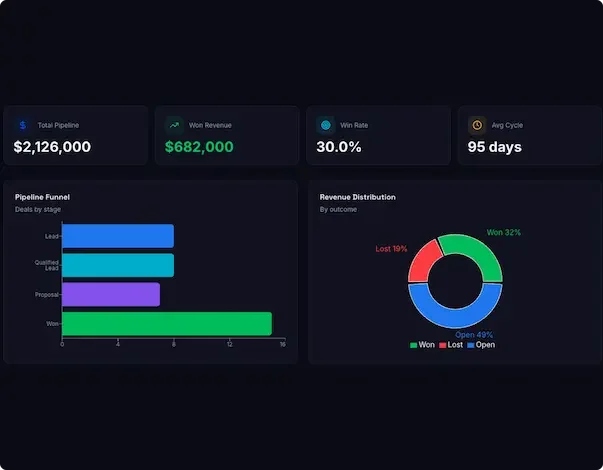
Financial Analytics That Turn Paid Media Into Commercial Clarity

We connect paid media performance to revenue, margin, and operational reality, helping leadership teams improve capital efficiency by 20 to 40 percent while gaining a single, trusted view of growth performance.

Why Financial Analytics Exists at Scale

As paid media spend increases, financial clarity rarely scales at the same pace. What begins as a manageable optimisation exercise becomes a material capital allocation decision, often without the financial frameworks required to evaluate risk, return, or sustainability. Platform performance may appear strong, yet leadership lacks confidence in what that performance actually means for revenue timing, margin, and cash flow.

Financial Analytics exists to close this gap.
Not because teams are underperforming, but because traditional paid media management does not account for the financial complexity that emerges as growth accelerates.

Platform Metrics Stop Explaining Business Reality

Platform Metrics Stop Explaining Business Reality

At scale, metrics such as CPA, ROAS, and volume provide an incomplete picture.

Accounts can show improving efficiency while revenue quality, margin contribution, or payback periods quietly deteriorate. Without a financial lens, optimisation decisions are made using signals that do not reflect the true cost or value of growth.

This creates situations where performance looks healthy inside ad platforms, but confidence erodes at the business level due to attribution mishandling.

Spend Scales Faster Than Financial Insight

Spend Scales Faster Than Financial Insight

Paid media budgets often grow incrementally, quarter by quarter, without a corresponding increase in financial visibility.

As spend rises, exposure compounds. Small inefficiencies become material, and decisions are made without clear guardrails around downside risk or capital efficiency. Without structured analysis, leadership is left reacting to outcomes rather than planning for them.

Financial Analytics introduces discipline where spend growth would otherwise outpace understanding.

Seasonality Is Rarely Modelled, But Always Paid For

Seasonality Is Rarely Modelled, But Always Paid For

Most paid media strategies assume performance behaves consistently over time.

In reality, demand intensity, conversion behaviour, and cost efficiency shift throughout the year. Without proper modelling, budgets are either overcommitted during low-intent periods or undercapitalised during peak demand.

This leads to missed revenue opportunities, unnecessary volatility, and avoidable pressure on cash flow. Seasonality does not create these issues. A lack of forecasting does.

Growth Decisions Are Made Without Forecasting Discipline

Growth Decisions Are Made Without Forecasting Discipline

Many growth decisions rely on historical averages or recent performance trends.

Without scenario modelling or sensitivity analysis, teams cannot assess how changes in spend, conversion behaviour, or demand will affect outcomes before decisions are made. This leaves leadership exposed to volatility and forces reactive adjustments after results have already materialised.

Financial Analytics provides the forward-looking discipline required to evaluate growth decisions before capital is committed.

How Blufire Approaches Financial Analytics

Financial Analytics is not a one-time exercise. It is an operating discipline that establishes a commercial baseline, models future outcomes, and continuously reconciles expectations against reality.

Commercial Understanding

We begin by building a complete financial and performance baseline across marketing, sales, and revenue.

This includes historical paid media performance, conversion behaviour, sales velocity, revenue timing, and margin structure. Where available, we align this data directly with your P&L to ensure every performance signal has commercial context. The goal is to create a single, accurate starting point that reflects how the business actually performs, not how individual platforms report success. This is also completed in consultation with you, to give us broader context of the numbers.

Define KPIs That Reflect Business Reality

Once the baseline is established, we define performance KPIs that leadership can trust. These KPIs extend beyond platform metrics and connect paid media activity to pipeline quality, revenue contribution, margin impact, and capital efficiency. We also account for sales team behaviour, including response times, close rates, and capacity constraints, as these materially influence outcomes.

This ensures performance is measured in terms that matter to the business, not just marketing.

Build Financial Sensitivity Models

With KPIs defined, we construct a financial model that forecasts outcomes across multiple scenarios. This includes modelling variations in spend, conversion rates, sales performance, and seasonal demand patterns. Sensitivity analysis is used to understand how changes in any variable affect revenue, margin, and cash flow.
Sales performance fluctuations are explicitly modelled, allowing leadership to see how changes in close rates impact overall results.

This step creates clarity around what needs to be true for growth to be profitable and sustainable.

Execute Within Financial Guardrails

Paid media execution and creative development are governed by the financial model.

Budgets, targets, and pacing decisions are set against agreed scenarios, ensuring growth is scaled within commercial and operational constraints. Seasonality assumptions guide investment timing to maximise opportunity while managing downside risk.

Execution remains disciplined as spend and volume increase.

Forecast vs Actuals and Recalibration

Each month, real performance is reconciled against the forecast and sensitivity models.

Paid media data, sales outcomes, and financial results are reviewed together to identify variance drivers, whether they stem from market conditions, execution changes, sales behaviour, or capacity limits.

Insights from this process are used to update assumptions, refine models, and recalibrate strategy, ensuring decisions remain grounded as conditions evolve.

The Business Outcomes Financial Analytics Creates

When financial analytics is embedded into paid media governance, leadership moves from reactive reporting to forward-looking decision-making. Across scaled accounts, this typically reduces performance volatility by 20–30% and improves confidence in capital allocation as spend grows.

Commercial Clarity at Scale

Forecast-driven modelling replaces hindsight reporting, giving visibility into revenue, margin, and cash flow impact before spend decisions are made. This commonly reduces inefficient budget allocation by 25–40% as investment scales.

Aligned Execution Across Teams

Marketing, sales, and finance operate from a shared performance model tied to pipeline and revenue outcomes. Teams using this approach commonly see 10–20% improvements in lead-to-sale conversion without increasing demand volume.

Predictable, Sustainable Growth

Spend is scaled within real operational and sales capacity, accounting for seasonality and close-rate variability. This typically stabilises month-over-month performance and supports 2–4x budget growth without margin compression.

Results Driven by Financial Governance

When financial analytics is embedded into paid media planning and performance governance, growth becomes more predictable, defensible, and scalable.

I Heat and Cool – 14M annual turnover business

Reduction in inefficient budget allocation

0 %

Decrease in Month to Month performance volatility

0 %

Increase in media investment without margin compression

0 %
I Heat and Cool – 14M annual turnover business

New annual revenue attributed to model-led scaling

$ 0 M

Reduction in wasted spend through margin-led forecasting

0 %

Year-on-year growth enabled by controlled paid media scaling

0 %

How Financial Analytics Integrates Into Growth Execution

Financial analytics provides the operating layer that connects paid media decisions to commercial outcomes and leadership oversight.

Clear Operating Rhythm

Financial analytics establishes a consistent cadence for planning, execution, and review. Forecasts, sensitivities, and targets are set upfront, then reviewed against actual performance on a monthly and quarterly basis.

This replaces reactive reporting with a predictable rhythm for decision-making as spend, pipeline, and revenue scale.

Shared Accountability

Marketing, sales, and finance operate from the same performance model. Paid media is governed against forecast assumptions, sales capacity, and margin impact, not isolated channel metrics.

This alignment removes subjective debates and creates clear performance ownership over outcomes.

Executive Visibility

Leadership gains a forward-looking view of performance, trade-offs, and risk. Financial analytics surfaces where growth is constrained, what levers are available, and how decisions affect revenue, margin, and cash flow.

This enables confident intervention when required, without micromanaging execution.

No one Else in the Industry Operates Like Us

APAC AWARDS

Built to feel in-house

Working with Blufire feels less like engaging an external agency and more like adding a senior growth function to your team. We embed ourselves in the context of your business, understand the constraints you operate under, and take responsibility for outcomes, not just activity.

You gain a partner who understands your goals, your internal dynamics, and the commercial implications of every decision, allowing growth initiatives to move faster and with greater confidence.

"During our monthly catch-ups, he always comes well-prepared and provides valuable, strategic advice to enhance our businesses performance."
– Lily Carafa,
Office Manager - MGIDC
PLATFORM 1

Driven by data, not by gut

Every recommendation Blufire makes is grounded in data, modelling, and real performance signals. We connect paid media activity to revenue, margin, and pipeline behaviour so decisions are informed by evidence rather than instinct.

This removes ambiguity from growth conversations and gives leadership teams a clear, shared view of what is working, what is not, and where to focus next.

"The team are across Meta and Google, and their regular updates and unlike the traditional agencies, have been working on the account and maximising results daily."
– Nick Jackson,
CMO, Peter Jackson
ADS COLLAGE 1

Designed for Real-World Constraints

Most growth partners optimise channels in isolation. Blufire operates differently by aligning paid media and creative execution with sales performance, financial outcomes, and operational capacity.

This approach gives leadership teams clarity on what is driving growth, where efficiency is lost, and how to scale without creating downstream issues. It is built for businesses where decisions have real commercial consequences, not theoretical upside.

"The Blufire team are one of the best Digital Marketing teams I've worked with in the last 10 years. Brendan and Cam are super responsive, know their craft extremely well, and are proactive in understanding our business needs to improve our rankings on SEO and activating our paid search plans."
– Jason Bulger,
CEO - Insider Sports

See The Results of what we do

Frequently Asked Questions

What is Financial Analytics in the context of Blufire?

Financial Analytics is the commercial layer that governs how paid media is planned, scaled, and evaluated.

Instead of looking at performance only through platform metrics, we model paid media against revenue, margin, sales performance, operational capacity, and seasonality. This creates a forward-looking view of what different spend decisions will actually produce before budgets are committed.

The goal is not reporting. The goal is confident, defensible growth decisions.

Standard reporting looks backward and focuses on what already happened.

Financial Analytics focuses on what is likely to happen next, and what trade-offs are involved.

We build financial and performance models that connect spend to pipeline, revenue, margin, and capacity. We then measure forecast versus actual outcomes monthly to understand variance, risk, and opportunity.

Dashboards show activity. Financial analytics informs decisions.

At minimum, we require access to:

  • Paid media performance data
  • Conversion tracking and analytics
  • Pipeline or CRM reporting
  • Revenue data and high-level margin visibility


Where available, we also incorporate:

  • Sales team response times and close rates
  • Operational capacity constraints
  • Historical seasonality patterns


If full access is not immediately possible, the model can be built progressively. The objective is to move toward a shared, accurate commercial view over time.

Seasonality is treated as a core input, not an afterthought.

We analyse historical performance across revenue, demand, sales efficiency, and delivery capacity to understand how results fluctuate throughout the year. Spend scenarios are then modelled against these patterns so growth plans reflect real-world conditions, not averages.

This allows leadership teams to scale aggressively during high-opportunity periods while avoiding margin erosion during lower-demand cycles.

Yes. Sales performance is explicitly modelled.

We account for variables such as response time, close rate, and pipeline conversion efficiency. Sensitivity scenarios are built to show how changes in sales execution impact revenue outcomes at different spend levels.

This removes the common ambiguity between marketing and sales and makes performance conversations objective rather than opinion-based.

Performance is reviewed monthly against the forecast.

Each month, we compare actual outcomes across spend, pipeline, revenue, and margin against the model assumptions. Variance is analysed to understand whether differences are driven by demand, sales execution, operational constraints, or external factors.

Quarterly reviews are then used to recalibrate assumptions, targets, and growth strategy.

Leadership receives:

A clear forecast tied to commercial outcomes
Monthly forecast versus actual analysis
Visibility into trade-offs, constraints, and risk
A shared performance model across marketing, sales, and finance

This allows decisions to move from reactive justification to proactive optimisation.

Financial Analytics is most valuable once growth becomes cross-functional.

This typically occurs once:

Paid media spend is material
There is a defined sales process or team
Revenue and margin matter more than volume alone

For early-stage businesses, simpler execution-focused approaches often deliver better ROI. For scaled organisations, financial analytics becomes essential to avoid volatility and inefficiency.

Financial Analytics is the foundation of the Growth System.

It informs how marketing execution is planned, how sales efficiency is evaluated, and how operational capacity is respected as spend scales. The other components operate inside the constraints and opportunities identified by the financial model.

Without this layer, growth decisions tend to rely on fragmented data and internal negotiation rather than evidence.

Initial insights typically emerge within the first 30 to 60 days.

Early value often comes from identifying inefficient spend allocation, misaligned targets, or unaccounted constraints. Over time, the compounding value comes from improved decision quality, reduced volatility, and more predictable growth outcomes.

This is a system designed for sustained performance, not short-term optimisation.

Ready to Bring Clarity to Your Growth?

If you are looking for a growth partner who combines paid media and creative execution with commercial discipline and clear accountability, Blufire may be the right fit.


We work with leadership teams who value clarity, alignment, and decisions grounded in real performance data.