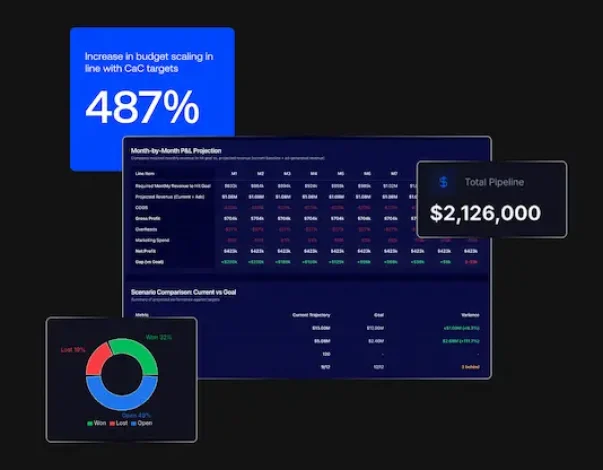
We analyse how lead demand moves through your sales pipeline to uncover conversion gaps and structural bottlenecks. The result is clear, data-backed insight into where small changes can materially improve revenue performance from paid media.


Many businesses reach a point where acquisition costs rise, conversion rates flatten, or revenue growth slows despite continued spend. The default response is often to change platforms, creative, or budgets, while the internal mechanics of how demand converts remain unexamined.
Pipeline analytics exists to solve this blind spot.
When paid media scales, small differences in how leads are handled, responded to, and progressed through the sales pipeline begin to materially affect outcomes. Without analysing these downstream variables, businesses are left optimising inputs while ignoring where value is actually created or lost.
Pipeline analytics brings visibility to the full path from lead to revenue, not just the point where spend occurs.
Ad platforms optimise for leads and cost efficiency, not revenue contribution.
In one instance, Meta appeared more efficient based on cost per lead, leading the client to consider reallocating budget. Pipeline analysis showed those leads converting at 13%, while Google Ads leads converted at 26% once they entered the sales process.
Without reviewing pipeline performance, the business would have shifted budget toward lower-quality demand, reducing total revenue despite lower acquisition costs.
As lead volume increases, internal handling becomes a limiting factor.
We have identified scenarios where average lead response time exceeded several days, despite consistent demand. When response time was reduced and tested over a defined period, conversion rates improved without any change to spend, targeting, or creative.
These issues are invisible at the platform level. Pipeline analytics isolates whether performance decline is driven by demand quality or internal execution before changes are made upstream.
Not all leads convert equally once they enter the pipeline.
In some cases, pipeline analysis revealed one sales rep closing at roughly 27% while another was closer to 56% on similar lead types. By identifying where conversion was strongest, leads were redistributed to the higher performer from paid media, improving overall revenue per dollar spent on paid media.
No change was made to budgets or platforms.
Pipeline analytics enabled better use of existing demand rather than increased acquisition.
Paid media amplifies whatever happens downstream.
When pipeline inefficiencies exist, scaling spend increases waste. When pipeline performance is understood, the same spend produces better outcomes.
Pipeline analytics ensures paid media decisions are informed by how leads convert into revenue, not just how cheaply they are acquired.
Ad platforms optimise for leads and cost efficiency, not revenue contribution.
In one instance, Meta appeared more efficient based on cost per lead, leading the client to consider reallocating budget. Pipeline analysis showed those leads converting at 13%, while Google Ads leads converted at 26% once they entered the sales process.
Without reviewing pipeline performance, the business would have shifted budget toward lower-quality demand, reducing total revenue despite lower acquisition costs.
As lead volume increases, internal handling becomes a limiting factor.
We have identified scenarios where average lead response time exceeded several days, despite consistent demand. When response time was reduced and tested over a defined period, conversion rates improved without any change to spend, targeting, or creative.
These issues are invisible at the platform level. Pipeline analytics isolates whether performance decline is driven by demand quality or internal execution before changes are made upstream.
Not all leads convert equally once they enter the pipeline.
In some cases, pipeline analysis revealed one sales rep closing at roughly 27% while another was closer to 56% on similar lead types. By identifying where conversion was strongest, leads were redistributed to the higher performer from paid media, improving overall revenue per dollar spent on paid media.
No change was made to budgets or platforms.
Pipeline analytics enabled better use of existing demand rather than increased acquisition.
Paid media amplifies whatever happens downstream.
When pipeline inefficiencies exist, scaling spend increases waste. When pipeline performance is understood, the same spend produces better outcomes.
Pipeline analytics ensures paid media decisions are informed by how leads convert into revenue, not just how cheaply they are acquired.
It is an operating discipline that connects paid media demand to revenue, post lead generation, by analysing how leads are handled, progressed, and converted once they enter the business.
We begin by establishing clear visibility across the sales pipeline.
This includes connecting to CRM data where available, validating lead source attribution, and mapping how leads move from initial enquiry through each stage of the pipeline. Where tracking is incomplete, we define the minimum structure required to measure performance accurately.
The objective is not to change how sales operates, but to create a reliable view of how demand is handled once it enters the organisation.
Once visibility is established, we analyse pipeline drop-off and revenue contribution by lead source.
Using historical conversion data and average deal values, we assess how different lead types perform as they move through the pipeline. This highlights where certain channels generate volume but underperform commercially, and where others deliver stronger revenue outcomes despite higher acquisition costs.
This step ensures paid media and referral performance is evaluated based on revenue contribution, not surface-level efficiency.
With lead source performance understood, we analyse how different leads convert across the sales team.
In many cases, performance varies significantly depending on the origin of the lead. Some sales reps consistently convert Google Ads leads more effectively, while others perform better with Meta or referral-based enquiries. Without segmentation, these differences remain hidden.
By isolating performance across lead sources, pipeline analytics reveals where internal strengths exist and where prioritisation can materially improve revenue efficiency.
Each month, we present a pipeline performance report that shows what happened to demand after it was generated.
This includes conversion performance segmented by lead source, pipeline stage, and sales handling, so you can see which channels are producing revenue and where leads are being lost. We then document the priority findings and the specific changes to test, such as response time improvement, follow-up gaps, or lead handling differences between sales reps by platform.
Pipeline performance is tracked against the forecasting model used across the Growth System.
As paid media spend or channel mix changes, we monitor whether conversion efficiency holds and whether revenue outcomes remain aligned with expectations. This allows you to scale budget with more confidence, because the downstream pipeline is being measured as volume increases, not assumed to remain stable.
If performance shifts, we isolate whether the driver is lead quality, lead mix, internal handling, or capacity constraints before any major budget decisions are made.
“The team at Blufire are professional, responsive, and easy to work with. They provide clear insight into performance and deliver measurable results across paid media and SEO. We’ve seen strong outcomes since engaging.”
“Nothing is ever too much trouble, and the team consistently go above and beyond to deliver quality outcomes. It’s clear they genuinely care about their clients and take pride in the work they deliver.”
“Blufire was a valuable partner during a period of significant change for our organisation. They were responsive, decisive, and brought the experience needed to move quickly and with confidence.”
“Blufire is one of the strongest marketing teams I’ve worked with in the past decade. They are responsive, highly skilled, and proactive in understanding our business to improve strategy and execution across paid media.”
“I’ve been very impressed with the improvements Blufire have made to our paid digital marketing at Peter Jackson. Their team is proactive, performance-focused, and consistently works to maximise results. They operate as a true partner.”
“Working with Blufire has been a game-changer for our marketing. Their team brought clarity, strategy, and deep expertise to our paid media, helping us better understand the platform and scale results with intention”
When pipeline analytics is embedded into paid media execution, performance is measured by revenue outcomes, not lead volume. This typically improves lead-to-sale efficiency, increases revenue per dollar of spend, and gives leadership more control as budgets scale.
Pipeline analytics isolates where leads are lost after enquiry, showing which pipeline stages and handling behaviours reduce revenue yield. We commonly uncover no follow up processes that suppress conversion and can be corrected without increasing media spend.
Source-level pipeline segmentation reveals which channels produce revenue, not just cheaper leads, by measuring lead-to-close performance after the click. In practice, we have seen channel conversion gaps such as 13% versus 26% that materially change budget allocation decisions.
Pipeline analytics validates whether conversion efficiency holds as spend increases by tracking pipeline performance against the forecasting model, not platform metrics alone. This allows spend to scale with commercial confidence, commonly supporting 2–4× budget growth because margin, close-rate capacity, and revenue yield are measured as volume increases, not assumed.
When financial analytics is embedded into paid media planning and performance governance, growth becomes more predictable, defensible, and scalable.
Improvement in pipeline velocity
Reduction in wasted spend from low converting sources
Increase in qualified opportunity rate from total leads
New annual revenue attributed to model-led scaling
Increase in spend according to better performing platform
Reduction in pipeline leakage through platform adjustment
Pipeline analytics provides the internal conversion layer that ensures paid media demand translates into revenue outcomes, not just lead volume.
Pipeline analytics connects lead generation to sales outcomes by measuring what happens after the enquiry enters the business. This creates clear ownership across marketing and sales by aligning performance to lead-to-revenue conversion, not platform metrics.
It ensures the Growth System is optimised end-to-end, not at the point of spend.
By segmenting pipeline performance by lead source and conversion behaviour, pipeline analytics clarifies which demand streams generate revenue and which inflate volume without returns. This informs channel strategy inside the Growth System and ensures spend is scaled toward demand that converts profitably.
This reduces budget decisions based on CPL alone and increases revenue efficiency from existing spend.
Pipeline analytics validates whether pipeline performance holds as budget increases, using the forecasting model as the reference point rather than ad account metrics in isolation. This gives leadership confidence to scale spend 2–4× when the business can absorb volume, maintain close rates, and protect margins.
This is what makes Growth Execution predictable at scale, not reactive.
Working with Blufire feels less like engaging an external agency and more like adding a senior growth function to your team. We embed ourselves in the context of your business, understand the constraints you operate under, and take responsibility for outcomes, not just activity.
You gain a partner who understands your goals, your internal dynamics, and the commercial implications of every decision, allowing growth initiatives to move faster and with greater confidence.
Every recommendation Blufire makes is grounded in data, modelling, and real performance signals. We connect paid media activity to revenue, margin, and pipeline behaviour so decisions are informed by evidence rather than instinct.
This removes ambiguity from growth conversations and gives leadership teams a clear, shared view of what is working, what is not, and where to focus next.
Most growth partners optimise channels in isolation. Blufire operates differently by aligning paid media and creative execution with sales performance, financial outcomes, and operational capacity.
This approach gives leadership teams clarity on what is driving growth, where efficiency is lost, and how to scale without creating downstream issues. It is built for businesses where decisions have real commercial consequences, not theoretical upside.
Blufire’s pipeline analytics is designed for businesses where paid media is already meaningful and leadership wants more revenue from the same demand, not just more leads.
This typically includes businesses with:
If you are not generating consistent demand yet, or you do not have a sales pipeline that can be measured, this will be premature.
No. Pipeline analytics is not sales coaching, team management, or process redesign.
We analyse what happens after leads are generated, isolate where conversion breaks down, and present insights and recommendations for your team to action.
The goal is commercial visibility and conversion efficiency, not changing how your sales team operates day-to-day.
Most reporting stops at lead volume and platform metrics like CPA or ROAS.
Pipeline analytics extends measurement into the business, showing how different lead sources convert through stages and into revenue, and where performance is being lost after the lead is created.
It replaces “we think sales is the issue” with evidence on what is actually happening.
Each month, you receive a structured pipeline performance report tied directly to demand sources.
It outlines performance by lead source, pipeline stage, and handling, plus the priority insights and recommended improvements to test for conversion efficiency.
This creates a consistent operating view of what is improving, what is slipping, and why.
We typically require CRM pipeline visibility so lead sources and outcomes can be connected.
At a minimum, this includes lead source tagging, stage progression, and closed outcomes so conversion can be measured beyond the ad platform.
If tracking is incomplete, we outline the minimum structure required to make the analytics reliable.
Yes. Lead source segmentation is central to the work.
Different sources often behave differently once they hit the pipeline, and performance only becomes clear when conversion is measured post-enquiry.
This is how channel decisions are made based on revenue contribution, not cost per lead.
No. We do not manage sales teams or enforce internal processes.
We surface performance differences by lead type and handling so you can decide how to prioritise resources internally.
If you choose to adjust lead handling, we track the impact and validate results over time.
Pipeline analytics connects paid media to downstream conversion and revenue capacity.
As spend increases, we validate whether conversion efficiency holds at volume and whether performance is aligned to the forecasting model, not just ad account metrics.
This is what supports scaling decisions without amplifying leakage.
You can usually identify high-leverage issues early once pipeline visibility is established.
Response time constraints, stage drop-off, and channel conversion differences tend to surface quickly when the data is clean enough to measure.
The ongoing value comes from validating improvements and keeping performance aligned as demand changes.
Pipeline analytics depends on visibility, but it does not require a perfect system on day one.
Where tracking is incomplete, we define the minimum viable pipeline structure required to measure conversion accurately and make the insights defensible.
Without this baseline, businesses are forced to make spend decisions in the dark.
We also offer a free CRM for your usage if needed.