














NewWeather Demand Modelling is live. Forecast demand before it arrivesWeather Demand Modelling is live

See where your margin is made, and exactly where it leaks.True contribution margin, down to the SKU.

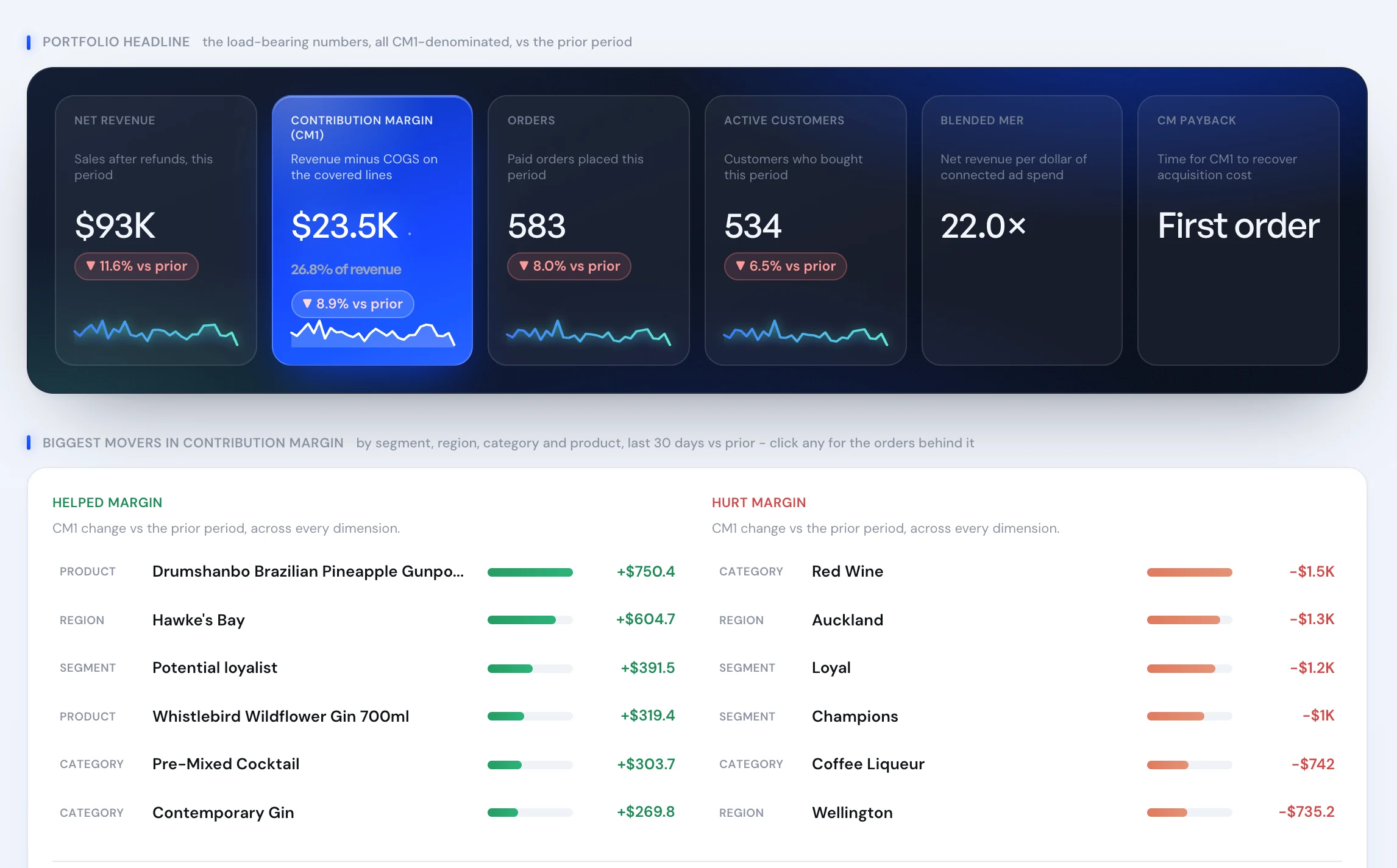
Unit Economics reads true contribution margin (revenue after COGS, shipping and fees) across seven dimensions: segment, category, sub-category, product, region, channel and cohort. You see which lines actually make money and which quietly lose it once real costs apply. One pivotable cube, a CM waterfall and bridge, ranked margin-by-dimension, cohort economics and a CM forecast, every cell drillable to the order behind it. We tell you where the leak is; we do not run your store.

Profitability CubeDemonstrative data
Profitability cube · contribution margin % by category × region (toggle: segment · sub-category · product · channel · cohort)
AucklandWellingtonSouth Is.Rest of NZBestsellers29%44%42%38%Core range25%39%37%34%New season31%46%44%41%Bundles17%31%29%27%Clearance-9%13%9%6%
Bestsellers run over 40% contribution in the core regions; the same stock runs thinner in Auckland once shipping and returns apply. Pivot the same cube to segment, sub-category, product, channel or cohort. Clearance is CM-negative in Auckland at -9%, a leak the blended margin hides.
Blended CM1
$2.08M
contribution in scope
Weighted CM1%
36.1%
of net revenue
AOV
$86
average order
CM1 per order
$30
unit-economics anchor
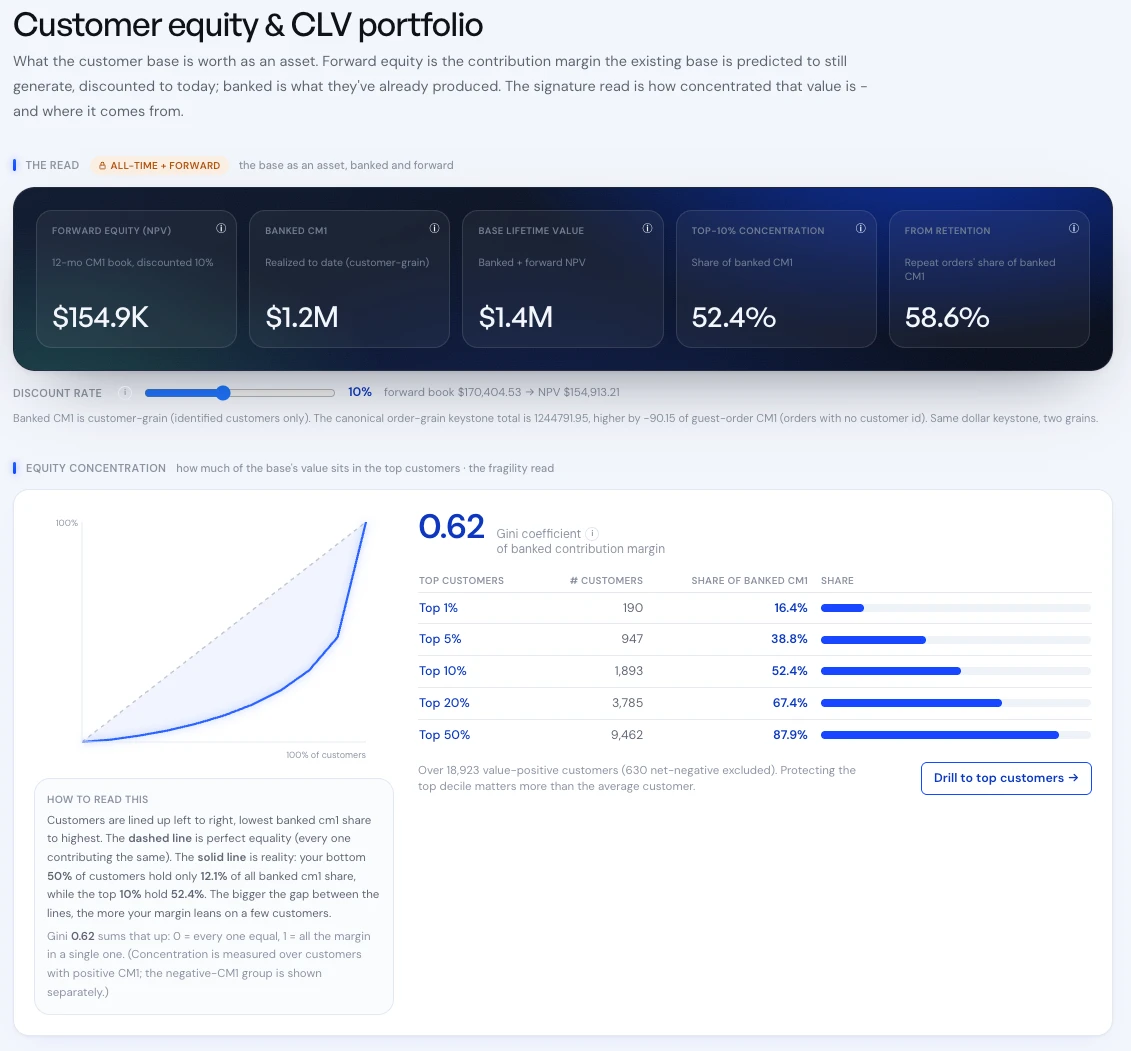
Concentration (Gini)
0.58
top 4 carry 80% of CM1
CM-negative values
5
across the seven dimensions
Margin intelligence from the award-winning team behind 100+ brands
PanasonicRainCoCheapest LiquorKing CoolingAuto ComfortiHeat & CoolAACAEInsider Experience SportsInterosPeter JacksonLa TrobeToy WorldForesightOncoreMindshopSurface SpectrumNAWTeafyEZI TagPanasonicRainCoCheapest LiquorKing CoolingAuto ComfortiHeat & CoolAACAEInsider Experience SportsInterosPeter JacksonLa TrobeToy WorldForesightOncoreMindshopSurface SpectrumNAWTeafyEZI Tag
Purest SolutionsCuratedVoir VodkaSwing & ServeNewLeafNavigataFirst EnergyHaldatecSirius GreenElite ElectricalMobile SkipsBrowedAsenoMGIDCRebateM8TMJ TutoringAcademic TutorsUCSPurest SolutionsCuratedVoir VodkaSwing & ServeNewLeafNavigataFirst EnergyHaldatecSirius GreenElite ElectricalMobile SkipsBrowedAsenoMGIDCRebateM8TMJ TutoringAcademic TutorsUCS
What it answers

The unit-economics questions revenue hides.

Not what you sold. What each sale actually kept, where the margin is made, and which lines lose money once real costs apply.

01
After every real cost, what margin is actually left?
Contribution margin is revenue after COGS, shipping and fees, measured on every order. The number you steer by becomes profit kept, not the price on the invoice.
02
Where is our margin made, and where are we bleeding it?
One pivotable cube of true margin across all seven dimensions: segment, category, sub-category, product, region, channel and cohort. Switch the lens or cross two at once in a 2-D heatmap; the strong lines and the leaks sit on the same screen.
03
Which lines lose money once real costs apply?
Margin by dimension ranks every value best to worst, flags the CM-negative tail in red, and shows how concentrated margin is with a Pareto cumulative and a Gini score, so the leak surfaces itself instead of hiding in a blended average.
04
Why did margin move period over period?
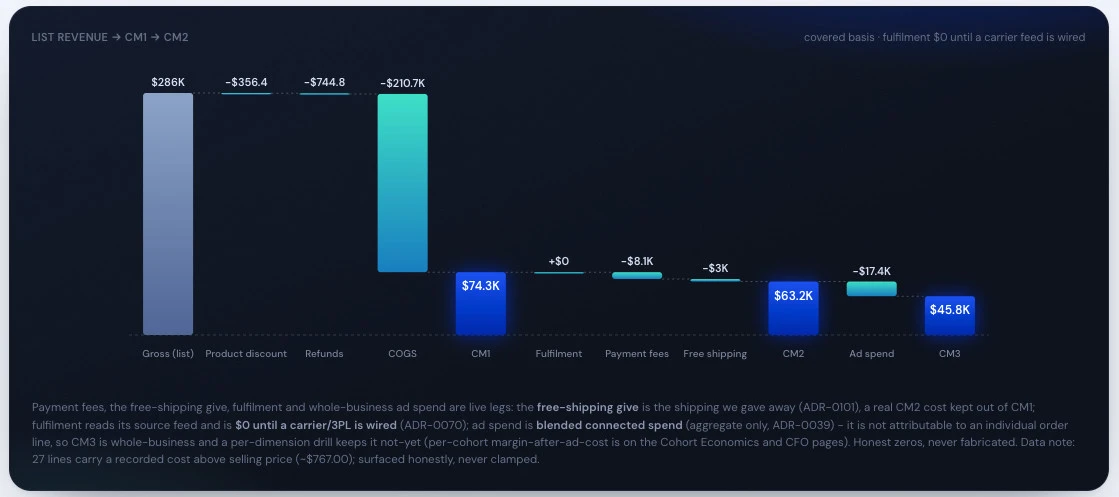
A CM waterfall down to true CM1 and a period-over-period bridge that splits the change into volume, price, mix and cost, so a drop is attributed rather than guessed.
05
Do the customers we acquire actually pay back?
Cohort economics in true contribution: the CM1-LTV triangle, blended CAC, first-order CM ladder and the days-to-payback climb, so you see which acquisition months recover their cost and how fast.
06
Where is margin heading, and what moves it most?
A deterministic CM forecast (trend × seasonal) on your own CM1 history, plus a what-if sandbox that recomputes CM1 off your real line economics when you flex price, COGS, volume, discount or refund rate.
The margin stepdown

See exactly what an order keeps.

Revenue is what an order is worth; contribution is what it keeps. The stepdown takes order value down through COGS, shipping and the payment and platform fees that move with every sale, so unit economics becomes a decomposition you can audit rather than a margin assumption applied across the board. Where cost data is missing we say so, and never fake a margin.

  • Order to contribution. Every cost that moves with a sale, deducted in order
  • Audited, not assumed. Each leg traces to its source, with COGS coverage shown
  • Never a fake margin. A missing cost renders honestly instead of as zero
See your margin stepdown
Unit Economics · margin stepdownDemonstrative data
Per-order margin stepdown · order value to true contribution
$0$43$86$86Order value-$38COGS-$10Shipping-$8Fees$30CM1
Of an $86 order, $38 is product cost, $10 shipping and $8 in payment and platform fees. That leaves $30 of true contribution, a 35% margin. Every order is decomposed to what it actually keeps, never a blended guess.
Margin by dimension

Rank every line, and see how concentrated the margin is.

A healthy blended margin can hide products that lose money on every sale, and it never tells you how fragile the margin is. Pick one of the seven dimensions and see its full CM1 distribution ranked best to worst, the CM-negative tail in red, and the concentration: a Pareto cumulative showing how few values make 80% of contribution, and a Gini score for how unevenly it is spread. So you know not just which lines to fix, but how exposed you are if the top few slip.

  • Ranked by contribution. Best to worst, with the CM-negative tail in red
  • Pareto & Gini. How few values carry the margin, and how fragile that is
  • Any of the seven. Segment, category, sub-category, product, region, channel or cohort
See your margin ranking
Unit Economics · margin by dimensionDemonstrative data
Contribution margin % by category · ranked, with cumulative share of CM1 (Pareto)
0%80% by 4 of 641%Optical frames36%Sunglasses28%Lenses19%Accessories-6%Cases & care-14%Clearance
The top 4 of 6 categories carry 80% of contribution (Gini 0.58, fairly concentrated), so if a couple of them slip, CM1 drops fast. Two turn margin-negative once true costs apply: cases and care barely break even, clearance loses 14c on the dollar. The amber line is the Pareto cumulative.
CM waterfall & bridge

See why margin moved, not just that it did.

The waterfall chains list revenue down through discounts, COGS, shipping and fees to true CM1 on the covered basis, so the margin number ties out leg by leg. Then the period-over-period bridge splits the change into the four forces that drive it: volume, price, mix and cost. A drop becomes an attribution you can act on, not a number you stare at.

  • Chains to CM1. List revenue to true contribution, every leg reconciled
  • Volume · price · mix · cost. The four drivers of period-over-period change
  • Scoped to any cell. Drill in from the cube to bridge a single category or region
See your margin bridge
Unit Economics · CM waterfall & bridgeDemonstrative data
Period-over-period CM1 bridge · prior to current, by driver
$0$1.0M$2.0M$1.86MPrior CM1+$220kVolume+$150kPrice-$80kMix-$140kCost$2.01MCurrent CM1
CM1 rose $150k period over period. Volume (+$220k) and price (+$150k) carried it, but a worsening mix (-$80k) and rising unit cost (-$140k) ate most of the gain. The bridge tells you which lever to pull, and the waterfall ties every leg to its source.
Cohort economics & payback

See if the customers you acquire pay back.

Every acquisition month is a cohort, tracked in true contribution margin over its life. The CM1-LTV triangle shows whether acquisition quality is drifting; the first-order CM ladder (CM1 to CM2 after fees to CM3 after CAC) and the days-to-payback climb show whether a customer pays for themselves on order one or relies on the repeat tail. Read down a column to compare cohorts at the same age, drill any cohort to its customers.

  • CM1-LTV triangle. Cumulative true contribution per customer, by cohort age
  • The CM ladder. First-order CM1, CM2 after fees, CM3 after CAC, and payback days
  • Break-even rank. Which order number clears the blended CAC, and how many reach it
See your cohort economics
Unit Economics · cohort economicsDemonstrative data
Acquisition-cohort CM1-LTV per customer · months since acquisition
M0M3M6M9M12
2024-09$24$41$58$71$86
2024-12$22$39$55$68$80
2025-03$26$45$63$78·
2025-06$28$49$69··
2025-09$30$53···
2025-12$31····
Recent cohorts are darker at the same age, so acquisition quality is improving: month-12 CM1-LTV climbed from $80 to a projected $86+. Against a blended CAC of $34, the average customer clears break-even by the second order. Per-channel CAC needs our own attribution and is built as a wired slot.
CM forecast & what-if

See where margin is heading, and stress-test it.

A deterministic, explainable forecast (an OLS trend times a multiplicative monthly seasonal index) projects true CM1 forward from your own history with a likely range, so you can plan inventory and cash around the seasonal peak. Then the what-if sandbox recomputes CM1 off the real line economics of the selected period when you flex price, COGS, volume, discount or refund rate: no black box, no demand-elasticity guess, and a sensitivity ranking of which lever moves margin most.

  • Trend × seasonal. Projected CM1 with a likely range, on your own history
  • Deterministic what-if. Flex price, COGS, volume, discount or refund and watch CM1 recompute
  • Lever ranking. Which single move buys the most contribution
See your CM forecast
Unit Economics · CM forecast & what-ifDemonstrative data
Monthly CM1 · realised (solid) and projected (dashed) with likely range
$0$150k$300kforecast →Dec peakJunSepDecMay
Next month projects at $214k of CM1, with the year peaking in December (about 38% above an average month). In the sandbox, a -5% unit COGS move adds the most contribution of any single lever, recomputed off your real order economics rather than a rule of thumb.
Where the numbers come from

Built on your store, reconciled to true profit.

Contribution margin is read straight off your orders and costs. The core unit economics need no ad connection at all.

Orders & revenue

Every order, refund and discount from your store, so revenue is net and real and attributed to the right SKU, channel and customer.

ShopifyWooCommerceBigCommerce

True cost

COGS, landed cost, shipping and payment fees per order, with a coverage badge on every margin, so contribution is the profit after the costs that move with a sale.

Cost feeds3PL / freightPayment fees

Deeper layers

CM2 (after payment fees) is live from Shopify Payments settlement. Blended CAC and the after-CAC ladder (CM3) light up as ad spend connects; the cohort, bridge and forecast all read in the same true CM1.

Payment feesGoogleMeta
Every figure is reconcilable to its source, a margin number a CFO signs off.
The team behind it

Built by an award-winning analytics team.

Margin OS comes from Blufire, trusted by 100+ mid-market and enterprise brands and recognised across the APAC and Global Search Awards. The same people now model your margin.

100+
Brands served
$5M-$1B
Turnover served
4
Industry awards
100 Fast StartersAPAC Search Awards 2025 WinnerGlobal Search Awards 2025 FinalistGlobal Agency Awards 2025 Finalist
Questions

The things buyers ask.

Contribution margin (CM1) is revenue minus the costs that move with a sale: COGS, shipping and fees. It is the profit a sale actually keeps. Denominating unit economics in it means you optimise for margin, not a revenue or gross-profit number that can look healthy while real costs eat it.
Shopify shows gross sales and, at best, a blended gross profit. We compute true contribution per order, SKU, category and channel, netting the shipping and fees Shopify leaves out, so you see which specific lines make and lose money rather than one company-wide figure.
Seven dimensions: segment, category, sub-category, product, region, channel and cohort. Segment is first-class, so you can read true margin by customer type, not just by what you sell. Switch the lens in place, or cross two dimensions at once in a 2-D heatmap, then drill any cell to the orders behind it.
No. The CM1 read (the cube, the waterfall, the margin-by-dimension ranking with Pareto and Gini, the cohort CM1-LTV triangle and the CM forecast) is computed from your store orders and costs alone, live on day one. CM2 (after payment fees) comes from Shopify Payments settlement. Blended CAC, the after-CAC ladder and per-channel splits light up as ad spend connects.
Yes. The CM waterfall and bridge split a period-over-period change into volume, price, mix and cost. The forecast projects true CM1 forward (an OLS trend times a multiplicative seasonal index) with a likely range, and the what-if sandbox recomputes CM1 off your real line economics when you flex price, COGS, volume, discount or refund rate.
We never invent it. Every margin carries a COGS-coverage badge showing the share of units with real cost data, and any line missing cost renders an honest cost-missing state rather than a fabricated or zero margin.
Reprice or cut the CM-negative lines, shift mix toward the segments, categories and regions that contribute most, protect the few values that carry most of the margin, chase down the cohorts that don't pay back, and stress-test a pricing or cost move in the what-if before you make it, with every decision made on true profit and drillable to the order behind it.

See where your margin is really made.

Connect your store and your costs. We reconcile every order to true contribution margin and show you, cell by cell, where the profit is made and where it leaks.

01

Connect your store

Orders, refunds and discounts. No data team.

02

Load your costs

COGS, shipping and fees, mapped with us.

03

Reconcile to true margin

One contribution number that ties out.

04

Open the cube

Pivot across all seven dimensions, drill to the order.

05

Bridge, cohort, forecast

Attribute the move, check payback, project CM1.

Book a demo Talk to an analyst