ROAS lies. Profit-led measurement is what is left.
Return on ad spend is the most trusted number in marketing and one of the least reliable. It double-counts sales, ignores margin, and rewards demand you already owned. Here is the arithmetic that replaces it.
ROAS overstates paid marketing in two compounding ways: ad platforms collectively claim credit for up to 140% of real revenue, and revenue itself says nothing about margin. Strip out the sales that would have happened anyway, denominate what is left in contribution margin, and judge every channel against its break-even (1 / contribution margin %) and its CAC payback. That is profit-led measurement.
A growth lead and a CFO can look at the same campaign and reach opposite verdicts. The growth lead sees a 4x return and asks for more budget. The CFO sees a loss and asks who approved the spend. They are both reading their dashboards correctly. The problem is that ROAS was never built to answer the question either of them is actually asking.
ROAS has two structural flaws, and they compound. The first is that it counts revenue the platform claims, not revenue the platform caused. The second is that it measures revenue at all, when the business runs on margin. Fix one and you still have the other. This piece walks through both, with the maths, and what an operator should report instead.
Why do the platforms claim more sales than exist?
Every ad platform sees only a slice of the customer journey and claims full credit for the conversion. One buyer who watches a TikTok video, later clicks a Google search ad, then sees a Meta retargeting impression generates a conversion in all three dashboards for a single real sale. The mechanism is mismatched attribution windows: Meta counts 7-day click and 1-day view, Google counts 30-day click, each platform applying its own logic to the same purchase (PantoSource, Multi-Platform Attribution, 2024).
Scaled across an account, the overlap is not a rounding error. The measurement firm Measured documents cases where ad platforms collectively claim credit for up to 140% of actual revenue (Measured, incrementality vs attribution vs MMM, 2024). In a worked example, 650 real orders surface as more than 1,200 reported platform conversions, an inflation near 85%. You cannot budget against numbers that sum to more than the truth.
The over-reporting is not evenly distributed. Independent benchmarking puts Meta roughly 26% above third-party analytics on average, driven by modelled conversions and last-event attribution, and Google Ads 15% to 20% high when Enhanced Conversions or Consent Mode modelling fills gaps (Varos industry benchmark, 2024).
What does an incrementality test actually show?
The question that matters is not whether a channel touched the sale but whether the sale would have happened anyway. That is incrementality, and it has a settled academic answer that predates the current attribution debate.
In a large-scale field experiment at eBay, economists Thomas Blake, Chris Nosko and Steven Tadelis switched off paid search on branded terms in some regions and left it on as a control. Almost all of the forgone paid clicks were immediately recaptured by organic results. The branded-search ads were buying traffic the company already owned. For non-brand terms, only new and infrequent users responded; frequent buyers drove most of the spend and almost none of the lift, leaving average measured returns negative (Blake, Nosko & Tadelis, "Consumer Heterogeneity and Paid Search Effectiveness," Econometrica, 2015).
That peer-reviewed result generalises into the planning rule operators use today: branded search runs 60% to 80% non-incremental and retargeting 40% to 70% non-incremental (Measured, 2024). The chart below plots what survives a holdout test. The teal bars are the return that would remain if you turned the channel off and measured the loss.
Why is a 4x ROAS not automatically profitable?
Even with perfectly incremental revenue, ROAS still measures the wrong thing. A 4x return on a 70% margin product is healthy. The same 4x on a 25% margin product loses money on every order. ROAS treats them as identical because it never sees the cost of goods.
The fix is one line of arithmetic. Break-even ROAS is the inverse of contribution margin: the lower your margin, the higher the return you need just to cover variable cost.
The median seven- and eight-figure ecommerce brand runs near 25% contribution margin, with a quartile spread from roughly 3% to 56% (Finaloop ecommerce margin data, US/global DTC, 2024; the arithmetic is currency-neutral, so it applies unchanged to an Australian brand reporting in AUD). At 25% margin, break-even is 4.0x. A brand celebrating a 4x ROAS at that margin is running at zero contribution before it has paid for a single hour of staff time. This is exactly how the marketing team and the CFO end up both correct and in violent disagreement.
Layer the two problems and the picture inverts. The 4x reported return falls toward 2.8x once incrementality is stripped out, and that lower true return sits below the 4.0x break-even the margin demands. The campaign the dashboard called a winner is destroying contribution. Neither flaw is visible in ROAS alone. Both are obvious once you do the arithmetic.
What should you report instead of ROAS?
Profit-led measurement does not need a more complex dashboard. It needs three numbers that ROAS cannot give you, judged on margin and on cause.
- Contribution margin per channel, not revenue. Denominate every channel in CM after landed COGS, fees and returns, then test it against the 1 / CM break-even.
- CAC payback in months. ROAS hides cash-flow reality: spend is upfront, returns arrive in lumps. Payback captures whether a customer repays acquisition cost before you run out of runway.
- Incremental, not reported. Validate the channels that drive the most spend with a geo holdout at least once or twice a year. Branded search and retargeting are where the inflation concentrates.
How much measurement does your spend level need?
The maturity ladder is set by spend, not by ambition.
Ladder per the Measured decision tree, 2024.
The tooling has caught up: Google's open-source Bayesian MMM, Meridian, reached general availability on 29 January 2025, putting causal-grade allocation within reach of mid-market teams (Google Meridian, general availability 29 January 2025). The same discipline is what IAB Australia's Advertising Effectiveness Council pushes local advertisers toward: controlled experiments as the way to validate spend and read incrementality, not platform-reported numbers (IAB Australia, Marketing Measurement Innovation Series).
Brands that triangulate across these independent sources rather than trusting one dashboard typically recover 10% to 25% efficiency by reallocating to causally validated channels, without spending another dollar (Measured, 2024). That recovered efficiency is what Blufire tracks as Profit Velocity: the rate at which marketing effort converts into durable contribution margin per dollar and per day. ROAS measures motion. Profit Velocity measures whether the motion is going anywhere.
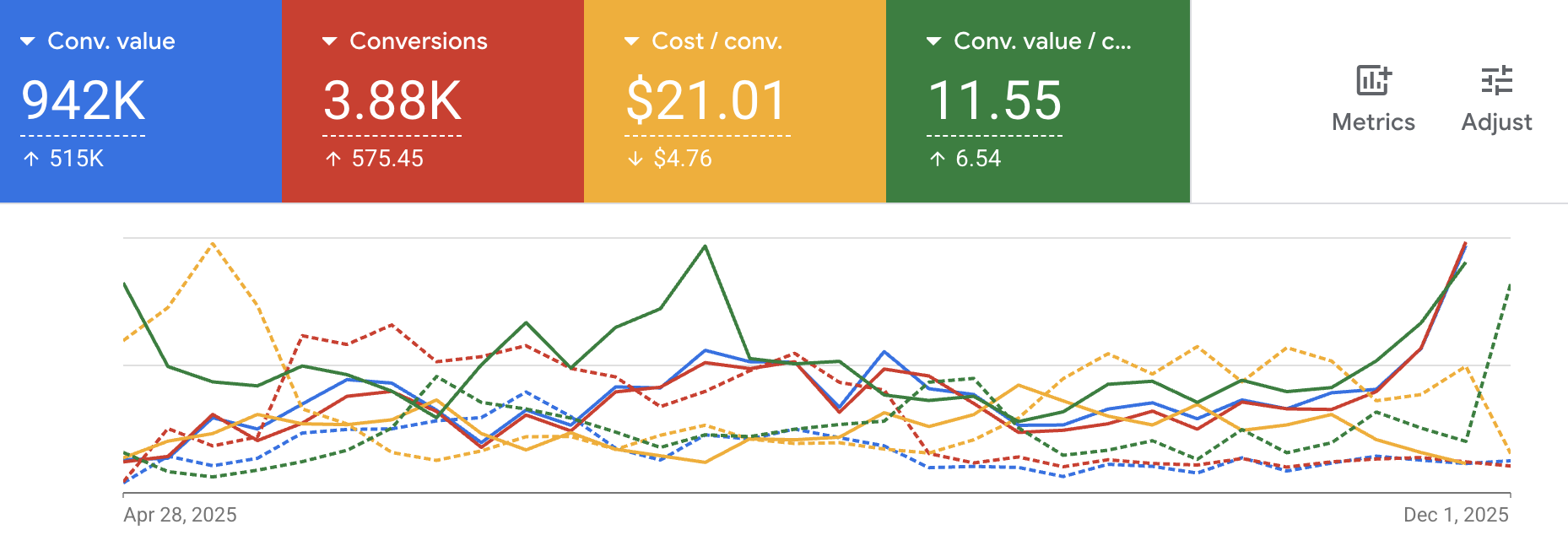
Peter Jackson: A$1.2M incremental revenue and a 53% reduction in cost of acquisition by judging spend on margin and incremental return rather than platform-reported ROAS, holding a 9.36 blended return through a 400% budget increase.
Read the full Peter Jackson case study →ROAS is not useless. It is a fast directional read on whether a tactic is alive. But it is a tool, not a truth, and it was never the number to allocate a budget on. Strip the double-counting, strip the demand you already owned, denominate what is left in margin, and judge it on payback. What remains is small, honest, and the only version worth scaling.
- Blake, T., Nosko, C. & Tadelis, S. (2015). "Consumer Heterogeneity and Paid Search Effectiveness: A Large-Scale Field Experiment." Econometrica 83(1). Peer-reviewed eBay holdout experiment on branded and non-brand paid search incrementality.
- Measured (2024). Incrementality vs attribution vs MMM decision tree. Platforms claiming up to 140% of revenue; non-incremental ranges; 2.1x true versus 4.8x reported; 10 to 25% efficiency from triangulation.
- PantoSource (2024). Multi-Platform Attribution. Mismatched attribution windows and the one-sale-counted-three-times mechanism.
- Varos industry benchmark (2024). Meta roughly 26% over-reported conversions versus third-party analytics; Google Ads 15 to 20% over-attribution under modelling (Enhanced Conversions / Consent Mode).
- Finaloop (2024). Ecommerce contribution-margin data (US/global DTC): about 25% median for seven- and eight-figure brands, 3 to 56% quartile spread. The break-even arithmetic is currency-neutral and applies to AUD reporting unchanged.
- Google Meridian. Open-source Bayesian marketing-mix model, general availability 29 January 2025.
- IAB Australia. Marketing Measurement Innovation Series and Advertising Effectiveness Council: controlled experiments as the standard for validating spend and reading incrementality in the Australian market.
Charts marked "Demonstrative data" use illustrative figures built by applying the cited published ranges to typical channel returns; they are not measured Blufire client results. The Peter Jackson outcome is a real client result from Blufire's case-study record.
Go deeper on profit-led measurement
Break-even ROAS calculator
The 1 / contribution margin arithmetic from this post, run on your own numbers. At 25% margin your break-even is 4.0x.
Open the calculator → GuideProfit-led measurement
The full playbook behind this post: contribution margin per channel, CAC payback in months, and incrementality testing.
Read the guide → BlogMore margin arithmetic
Attribution, CAC and contribution-margin thinking for operators, in plain numbers.
All 13 posts →