Reallocate to what actually pays.
Every ad platform claims the sale. The next dollar should go where it truly earns its keep, judged on marginal return and reconciled to margin, not on the credit a platform grants itself. Blufire shows you where that dollar pays.
Put the next dollar where it actually pays.
Ad platforms are graded by their own homework. Each one counts the sale it touched, so their reports add up to more conversions than the business ever made, and budget drifts to whichever channel claims loudest. The decision that grows profit is not which channel claims the order, it is where the next dollar earns its keep. That means optimising on marginal return, the profit from the last increment of spend, not the flattering average a platform reports. Blufire triangulates real demand against margin so you can see it.
See where the next dollar pays, not who claims it.
Compare platform-claimed sales to true incremental
Lay every platform's self-reported conversions next to one another and watch the claims sum past one hundred percent of real sales. The same order, counted by Meta, Google and TikTok at once, inflates each channel's apparent return. Blufire deduplicates against actual demand so you see the incremental sales each channel truly drove.
Read the marginal ROI curve by channel
The first dollar into a channel returns far more than the last. Blufire plots return against spend so you see the curve flatten and then turn down, the point where extra budget stops paying. The next dollar belongs wherever its marginal return is highest, which is rarely the channel with the biggest average ROAS.
See payback by channel, not just ROAS
A channel can post a strong ROAS and still tie up cash for months before the customer pays it back. Blufire shows how long each channel takes to return its acquisition cost in contribution margin, so you can fund the channels that recover quickly and watch the slow ones with open eyes.
Judge channels on profit, against breakeven ROAS
ROAS without margin is a number that cannot be banked. The honest bar is breakeven ROAS, which is one divided by contribution margin, the return a channel must clear just to wash its face. Blufire sets every channel against its own breakeven so a 3:1 ROAS on a thin product reads as the loss it really is.
Channel and CAC views are powered by Blufire attribution and unlock as your own attribution is connected.
True attribution from Blufire's own engine
Channel and campaign return are resolved by Blufire's own attribution, triangulated across platform signals, site behaviour and real demand, never a last-touch guess lifted from your store. The comparison is plain: the platform's flattering number on one side, the deduplicated incremental return on the other, so you can move spend on the truth.
The surfaces that do the job.
The decisions you can finally make.
Fund the marginal winner
Move the next dollar to the channel with the highest marginal return, where extra spend still earns its keep rather than the one that claims loudest.
Force incremental acquisition
Pull spend off audiences that would have bought anyway, such as your own brand, and prove which budget genuinely brings new customers in.
Keep spend where it pays
When a channel clears its breakeven and pays back fast, fund it with confidence. This page shows where the dollar pays; it never tells you to simply spend less.
Reallocation, in the numbers.
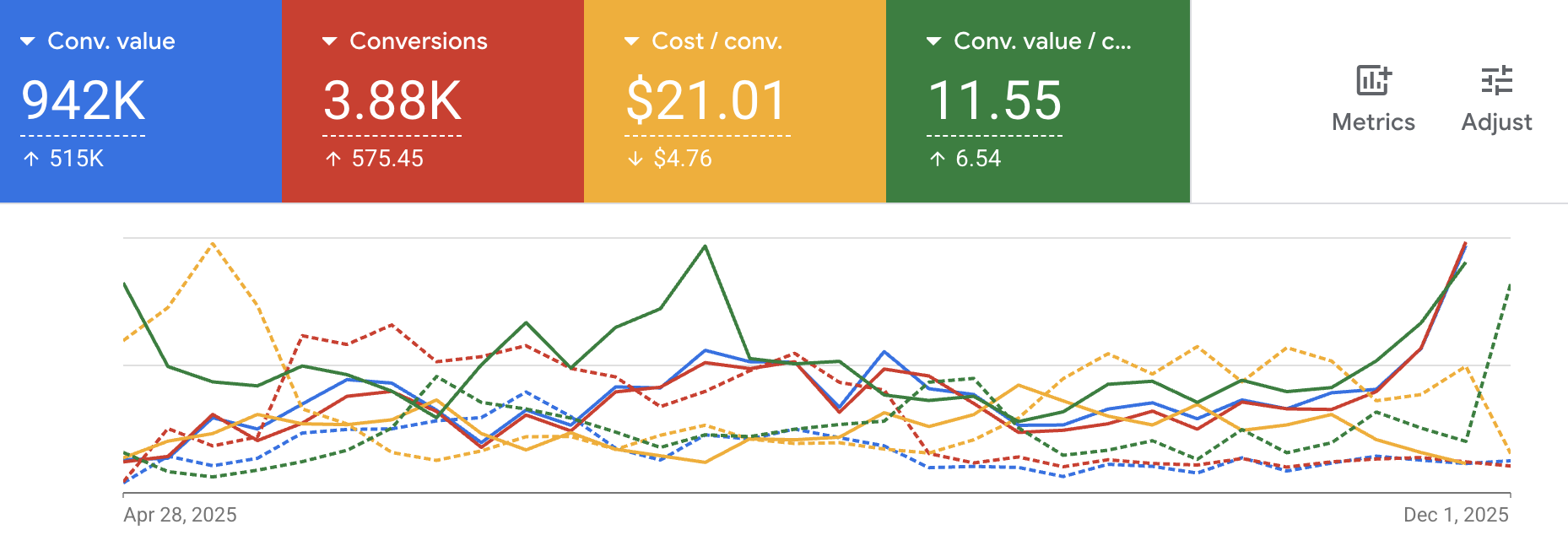
Real Blufire engagements where measuring true incremental return, then moving the spend, changed the result.


Built for profit-led operators.
Channel and campaign spend judged on incremental, margin-true return rather than platform-claimed ROAS. Go deeper in the Profit-Led Measurement Guide.
Spend reallocated by where leads turn into won, profitable pipeline, not by last-touch credit. See the Marketing Profitability Report.
Weather and seasonality move demand long before your sales report shows it. Blufire reads the degree-day signal 30 to 45 days ahead, so you place spend into in-season demand instead of chasing it after the peak has passed.
Your average CAC hides the number that actually matters: what the next customer costs at the margin. Blufire separates blended, new-customer and marginal CAC, ties each one to contribution margin, and shows you where the next dollar of spend still pays back.
Revenue tells you what sold. Margin tells you what made money. Blufire shows you exactly where profit leaks across products, channels and customers, and the move that fixes it.