What's Inside / The customers / S8 Persona Analytics
Buyer personas built from what your customers actually buy
Most buyer personas are written in a workshop: a stock photo, a first name, and a guess about what she reads on weekends. Section S8, Persona Analytics, builds them from your own customers instead, and prices each one in margin, so the persona you brief is the one that pays.
Persona Analytics names your customer base as audiences, shows where each over- and under-indexes demographically and psychographically, and sizes the lookalike headroom left. Every audience carries a grounded creative brief, its acquisition levers and a persona x product matrix that drills to real products.
5.0 on Google · 100+ businesses · $153M revenue influenced
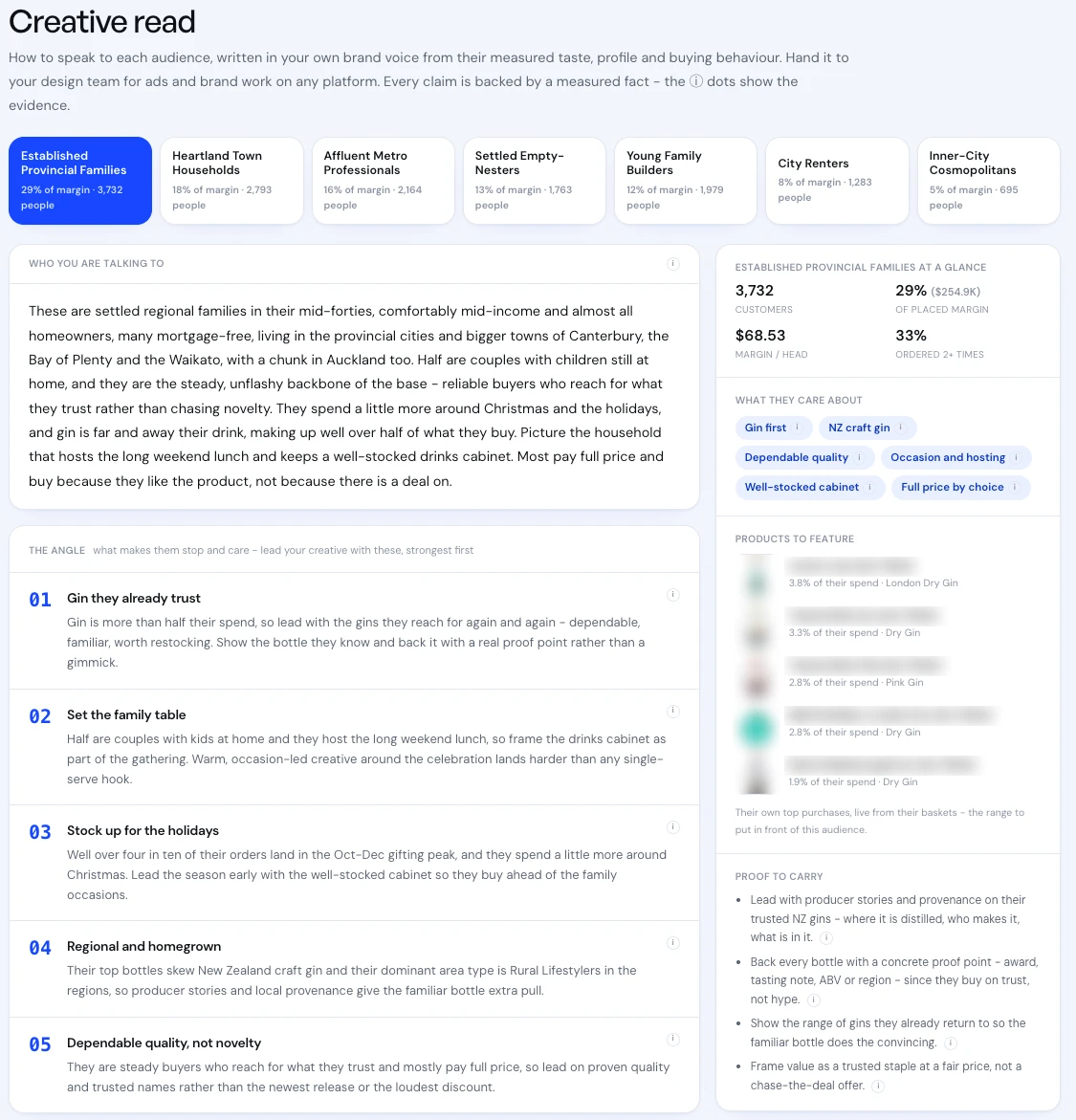
Real product screen, shown on sample data.
Each audience, named, sized and briefed.
The Creative read opens on the audiences themselves, each with its share of margin and its head count. Pick one and you get who you are talking to in plain prose, the angles that make them stop and care in order of strength, the products to feature (their own top purchases), and the proof to carry in the ad.
Every claim is backed by a measured fact, and a small evidence marker beside it shows what the fact is. An at-a-glance panel gives the audience's customer count, share of margin, margin per head and the share who ordered twice or more.
“They took the time to understand our business and goals, and delivered a clear, customised strategy that actually worked.”
 A$942kin incremental revenue once the double-counted attribution was fixedRead the case study →










Two personas, one acquisition budget.
Two audiences from the same store. Both cost about A$40 to acquire per new customer. Margin per head is the CM1 each customer has produced so far.
Persona B is the bigger audience and would win any vote about who "our customer" is. It is also the one that loses money to acquire. Persona A is smaller, earns more than twice the margin per head, and is the one worth finding more of, as long as the lookalike headroom is there.
Margin per head grows as customers repeat, so read it alongside the share who order twice or more. Work out what you can afford to pay per customer with the blended CAC calculator and the definition of margin LTV.
From a persona poster to a persona that pays.
Personas are invented in a workshop and never checked against orders.
Audiences are built from your customers and sized by share of margin.
The biggest audience is assumed to be the best one.
Margin per head and repeat share show which audience is worth acquiring.
"Find more like our best customers" is a wish.
Lookalike Headroom sizes how many more there are, and the levers show how to reach them.
Creative briefs start from taste.
Each audience has a grounded brief, with the evidence behind every claim.
Who are our best customers, and how do we find more of them?
The honest version of a buyer persona is a group of real customers who share traits and behave alike. Once you have that, the useful questions are commercial. Which audience carries the most margin per head? What do they buy first? Which channels and offers bring them in? How many more like them are there?
That is the whole of finding more of your best customers. The mosaics say who they are. Lookalike Headroom says how much room is left. The acquisition levers, first-order size and entry products, say how to reach them. The creative brief says what to show them. Together they turn "find more of them" into a brief you can hand to a media buyer.
Each audience is sized by its share of margin, not its share of revenue, so a big-spending group that leaves little behind does not get mistaken for the best one. For the value of individual customers inside those audiences, see Customer Value & Segmentation.
A brief for marketing, a map for everyone else.
The CMO and the media buyer take the creative brief and the acquisition levers into prospecting, then read how that creative performs in margin in Creative Analytics.
The founder reads the share of margin per persona. It is usually the first time the business can say who its customers are in a sentence that is backed by orders rather than opinion.
The designer or agency works straight from the creative read: who you are talking to, the angles in order, the products to feature and the proof to carry, each with its evidence.
Ops and merchandising read the persona x product matrix, because the products each audience returns to are the range worth keeping in stock and in front of them.