Problems we solve / The customers / Find more best customers
Problem 08 of 16 · The customersWe know our best customers exist. How do we find more of them?
Most brands describe their best customer as an age bracket and a postcode, then ask Meta to find more of them. A customer persona built from what people actually buy, at what price and how often, is a far sharper brief, and it can be scored on the margin those customers leave behind.
Start from the customers who leave the most contribution margin, group them by how they buy, and name each group as an audience. Blufire's Persona Analytics does that from your order history, sizes the Lookalike Headroom left in each audience, and hands you a grounded creative brief for finding more.
5.0 on Google · 100+ businesses · $153M revenue influenced
Your targeting describes a demographic. Your best customers are a behaviour.
Ask who the best customer is and most teams give an age range, a gender and a city, because that is what ad platforms let you target. But two women aged 35 to 44 in the same suburb can be a full-price regular who reorders every six weeks and a one-time buyer who only arrived through a 30% code. On a targeting screen they are the same person.
Lookalikes inherit the problem. The platform models from your seed list and optimises to clicks or purchases, not to who buys at a profit. Seed it with top spenders and you ask it to find more of a list that already mixes your most valuable buyers with your most discount-dependent ones. The spend list and the margin list are rarely the same.
The real signal is already in your orders: entry category, first basket size, full price or discount, how often they come back. People who buy the same way are more alike than people who share a birthday. That is what a useful customer persona is made of, and the only version you can check against margin LTV.
The decision you walk away with.
The best customer is an age range and a postcode.
The best customers are named audiences built from how they buy, with their share of margin beside them.
Lookalikes are seeded from all purchasers or top spenders.
Seeds are chosen on margin, and Lookalike Headroom shows how far each audience can scale.
Creative is briefed to a demographic and judged on clicks.
Creative is briefed to a persona, with the angles and proof it responds to.
"Find more of them" is a goal with no plan behind it.
Each audience carries its entry products and first-order size: the levers that acquire it.
Two ads on equal spend, judged on customers and then on margin.
Same product, same budget. One ad is broad and discount-led. The other is written to a persona built from purchase behaviour. Contribution per customer is margin over their first year, after discounts and returns.
A dashboard that counts customers or clicks scales the broad ad, because it found 50 more people. On margin the persona ad earned about 2.6x as much (A$4,340 ÷ A$1,680), because the broad ad pulled deal-seekers who bought once, on discount, and left.
The angle follows too. A persona that buys on craft and provenance scrolls past a 48-hour countdown; a deal-seeker responds to it and leaves little behind. The persona tells you the angle. Its contribution margin tells you whether it is worth finding at all.
Which of your two ads brings in more margin?
Enter the new customers each ad brings in on equal spend and what one of those customers is worth in margin, and see whether your volume winner is also your margin winner.
On volume, the broad ad wins, more customers, better clicks. On the profit it brings in, the persona ad wins by 2.6x. Optimise to clicks and you scale the wrong one.
A two-ad sketch. Blufire builds your personas from purchase behaviour and scores every creative against them, in margin. Nothing you type here leaves your browser.
Your base as named audiences, each with a brief attached.
Section S8, Persona Analytics, groups the base into nameable audiences from purchase history. Each shows its share of your margin, its headcount and margin per head, so you see which persona carries the business.
Each audience also carries its acquisition levers, first-order size and entry products, so "find more of them" becomes a brief you can hand to a media buyer or a designer.
- Demographic and psychographic mosaicsWhere each audience over- and under-indexes against the market, so targeting starts from who they are rather than a guess.
- Lookalike HeadroomHow many more of each audience are left to find, before you spend on a lookalike with nowhere to go.
- Creative readA grounded brief per audience: who you are talking to, the angles that make them stop, products to feature and proof to carry, each claim backed by a measured fact.
- Persona x product matrixWhich products each audience actually buys, drillable down to real products.
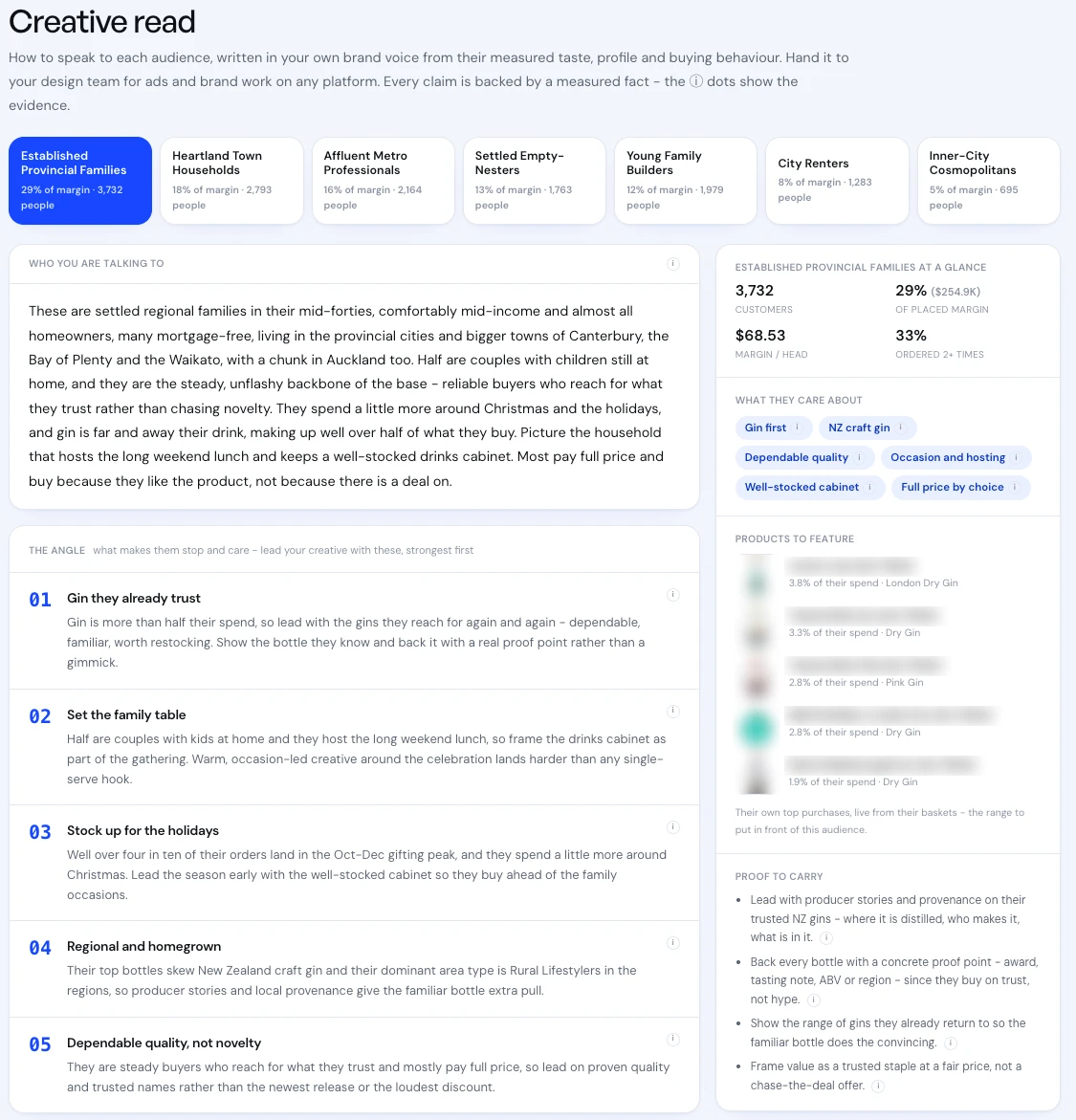
Real product screen, shown on sample data.
The team behind the numbers.
 A$5k to A$170ka month in eight months, with the finish carrying 85% of revenue de-riskedRead the case study →
“They took the time to understand our business and goals, and delivered a clear, customised strategy that actually worked.”














Building a customer persona that holds up.
- Start from margin, not spend.Rank customers on what they leave after COGS, shipping, discounts and returns. RFM segmentation run on revenue puts your most expensive buyers at the top.
- Group by behaviour first.Entry category, cadence, price sensitivity and first product separate customers far better than age and gender. Add demographics afterwards, to describe a group, not to define it.
- Check the persona has room to grow.An audience that carries a lot of margin but has little headroom left in the market is one to protect, not one to pour spend into. See value concentration.
- Tie every ad back to who it acquired.Match new customers to the creative that brought them in, then to their margin over time, and to the channel and first product they came through.