What's Inside / The money / S3 Discounting
An ecommerce discount strategy built on who actually needs the code
Most discount strategy is a calendar: a sale in spring, one at end of financial year, a big one in November. Section S3, Discounting, plans it around people instead, because the same 15% off is a smart offer to one customer and a pure giveaway to another.
Discounting bands every customer by how dependent they are on a code, scores every promo's give against the margin behind it in the Promo Ledger, and lets you simulate one promo or the whole calendar before it runs. Discount-dependent buyers worth moving back to full price become a win-back list.
5.0 on Google · 100+ businesses · $153M revenue influenced
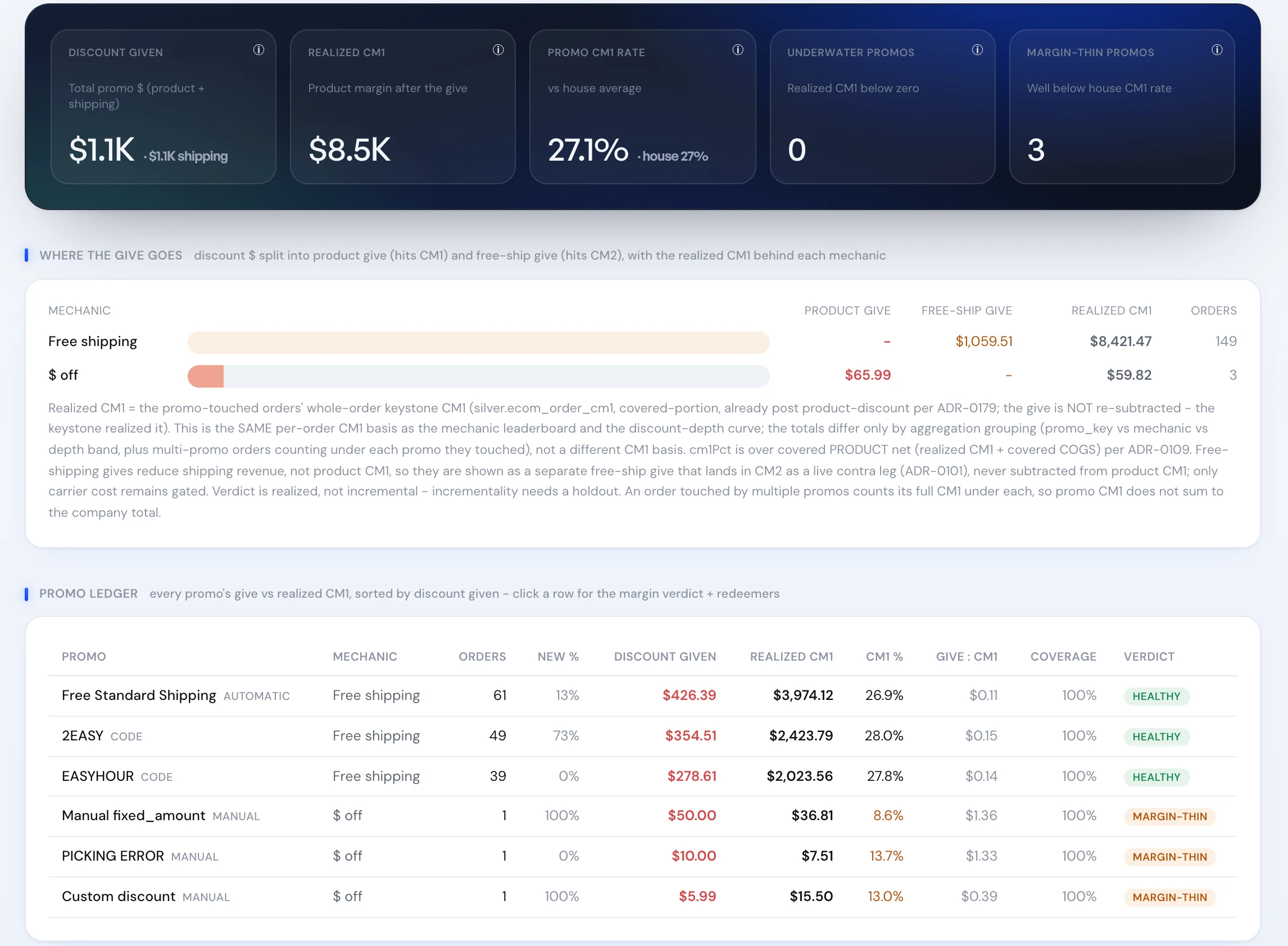
Real product screen, shown on sample data.
Every promo, and where its give went.
The top of the section reads the period's discounting in one row: discount given, the CM1 left after it, the promo CM1 rate against your house average, and how many promos are underwater or margin-thin. Below that, the give is split by mechanic into product give, which hits CM1, and free-shipping give, which lands in CM2.
The Promo Ledger then lists every code, automatic discount and manual adjustment, with its orders, share of new customers, discount given, realised CM1 and a verdict. Click a row for the redeemers behind it. For the full method on scoring a single code, see which discount codes are quietly giving margin away.
“Quick to take action, and bring a lot of experience… a partner who can strategically execute and adapt to fast-paced industries.”
 A$0 to A$1Min under 12 months, in one of retail's most price-brutal categoriesRead the case study →










Four kinds of customer, four different offers.
Dependency is a lifetime property, so the bands read every customer's whole history rather than one date range. Full-price loyal customers buy without a code, and discounting them is pure leak. Mixed customers sometimes use one. Discount-dependent customers used a discount on more than half their orders. Discount-only customers have never bought without a promo.
Each band shows its customer count, the CM1 it has produced and the discount dollars it has received, so you can see where the give actually lands. A common pattern is the smallest bands soaking up the most discount while the biggest band barely needs it.
That changes the strategy question. It stops being "how deep should the sale go?" and becomes "who should see it?". A code aimed at discount-only buyers is an acquisition cost you can weigh against new-customer CAC. The same code sent to the full list hands margin to people who were going to pay full price anyway. Guests with no customer record are excluded from the bands, so the read is about people you can actually target.
Planning the calendar with the whole table.
The CMO or retention lead owns the calendar. Before a promo is briefed, it goes through the Promo-Restructure Simulator, and the audience is cut by dependency band rather than sent to the whole list.
The founder reads the verdict column. A promo marked margin-thin gets restructured; one that is underwater gets killed. The share of new customers on each row says whether a code is finding people or just paying existing ones.
The CFO reads discount given against realised CM1 and the promo CM1 rate against the house average, because a promo calendar is a margin budget whether or not anyone calls it one.
Ops plans stock against the calendar that survives the simulator, not the one copied from last year.
From a sale calendar to a discount strategy.
Every promo goes to the whole list.
The audience is cut by dependency band, and full-price loyal customers keep paying full price.
Free shipping is treated as free.
Free-shipping give is its own line, landing in CM2 next to product give.
Manual discounts and one-off adjustments are never reviewed.
Every code, automatic and manual discount sits in one ledger with a verdict.
The calendar is judged after it runs.
One promo or the whole calendar is simulated on margin first.
One promo week, planned two ways.
1,000 customers expected to buy in a 15% off week. A$90 average order, 50% CM1 at full price, so each order earns A$45, or A$31.50 after a A$13.50 discount. Plan A sends the code to everyone. Plan B holds it back from the full-price loyal band, who buy at full price regardless.
Same discount, same week, same customers. Plan A loses A$2,250 of margin. Plan B earns A$5,850, a swing of A$8,100, which is exactly the give that went to people who did not need it.
The split between "would buy anyway" and "genuinely new" is the assumption to test, not trust. The ledger shows realised CM1; proving incrementality needs a holdout, which Experiments runs. Try your own depth and volume in the discount impact calculator.