Problems we solve / The marketing / Email and SMS money
Problem 11 of 16 · The marketingEmail and SMS are leaving money on the table. Where?
Email and SMS usually look like your best channel, because the platform reports the revenue every send touched. Klaviyo segmentation is built on what Klaviyo can see: order value, dates and engagement. None of that is profit, so the money left on the table sits inside segments that look healthy on revenue.
Read every flow and campaign in CM1, then rebuild segments on margin and push them back to Klaviyo. Blufire's Activation Bridge dispatches margin-true audiences, and its Audience Payback Ledger reads whether each one actually returned contribution margin.
5.0 on Google · 100+ businesses · $153M revenue influenced
Klaviyo segments on what it can see, and cost is not in it.
Every segment you can build in Klaviyo is made from its own data: order value, order dates, products viewed, opens and clicks. Its predictive metrics forecast spend, not contribution. None of it includes landed COGS, shipping, payment fees, the discount a customer lives on or the returns they send back. So a VIP segment ranks people by revenue, and revenue and margin are not the same list.
That creates two leaks at once. Discounts go to the wrong people: the full-price regular gets the same 20% code as the buyer who has never paid full price, which marks down sales you already had (the trap covered in discount codes). And the sends that top the revenue report are often the discount-heavy ones, so the programme learns to send more of them.
The reporting makes it worse. Klaviyo credits a send with orders inside its attribution window after an open or click, including orders Meta or branded search also claim, so the margin a send caused is far smaller than the revenue it reports. Who gets the credit covers that overlap.
The decision you walk away with.
VIP segments rank customers by spend.
Segments rank customers by the contribution margin they leave.
Every send takes credit for every order in its window.
Each send shows its attributed CM1 next to what Klaviyo claims.
Full-price regulars get the same code as discount hunters.
Full-price loyalists get a protect message, and the code goes where it creates a sale.
An audience is pushed and nobody checks what came back.
The Audience Payback Ledger reads treatment against holdout, in CM1.
Two sends, ranked on revenue and then on margin.
Two campaigns in the same month. One went to the top-spend segment with a code. The other went to a margin-true segment of full-price regulars with a new-range message.
The revenue report crowns Send A by A$12,000. The bank account prefers Send B by 2.8x (A$8,960 ÷ A$3,200). Most of Send A's revenue was margin handed back as discount to people who were already buying.
It holds per customer too: two VIPs each spending A$2,400 a year can leave A$180 (all on discount, 28% returned) and A$1,050 (full price, 2% returned). A revenue segment sends them the same offer. Try your own figures in the contribution margin calculator.
Which of your two segments actually pays?
Enter the revenue a send to each segment brings in and its true contribution margin after discounts and returns, and see whether the profit ranking flips the revenue one.
On revenue, Segment A looks like the winner. On the profit it actually makes you, Segment B is worth 2.8x more. Your email tool would send to the first one.
A quick sketch on two segments. Blufire builds margin-and-persona-true audiences across your whole list and pushes them straight to Klaviyo. Nothing you type here leaves your browser.
Margin-true audiences go out, contribution margin comes back.
Section S9, Activation Bridge, starts with the Owned-Channel Overview: flows against campaigns against total, all read in CM1, so you can see which sends earn margin and which just move discounted volume. Each send's attributed CM1 sits next to the conversions and value Klaviyo reports, as a reference rather than the answer.
Segments built on margin in the customer section, from the top CM1 decile to full-price loyalists, dispatch to Klaviyo through the bridge. Sync health and the intervention log confirm the audience landed, and the Audience Payback Ledger reads the round trip, treatment against holdout, in contribution margin.
- Owned-Channel OverviewFlows versus campaigns versus total, in CM1, so a send that moves discounted volume stops looking like a winner.
- Activation BridgePush a margin-true segment to Klaviyo, Google or Meta, with sync health and an intervention log confirming it landed.
- Audience Payback LedgerEach audience's round trip read in CM1, treatment against holdout, so you know whether the activation paid for itself.
- Activation calendar and registrySchedule dispatches, watch audience pressure, and keep one canonical audience registry with full lineage.
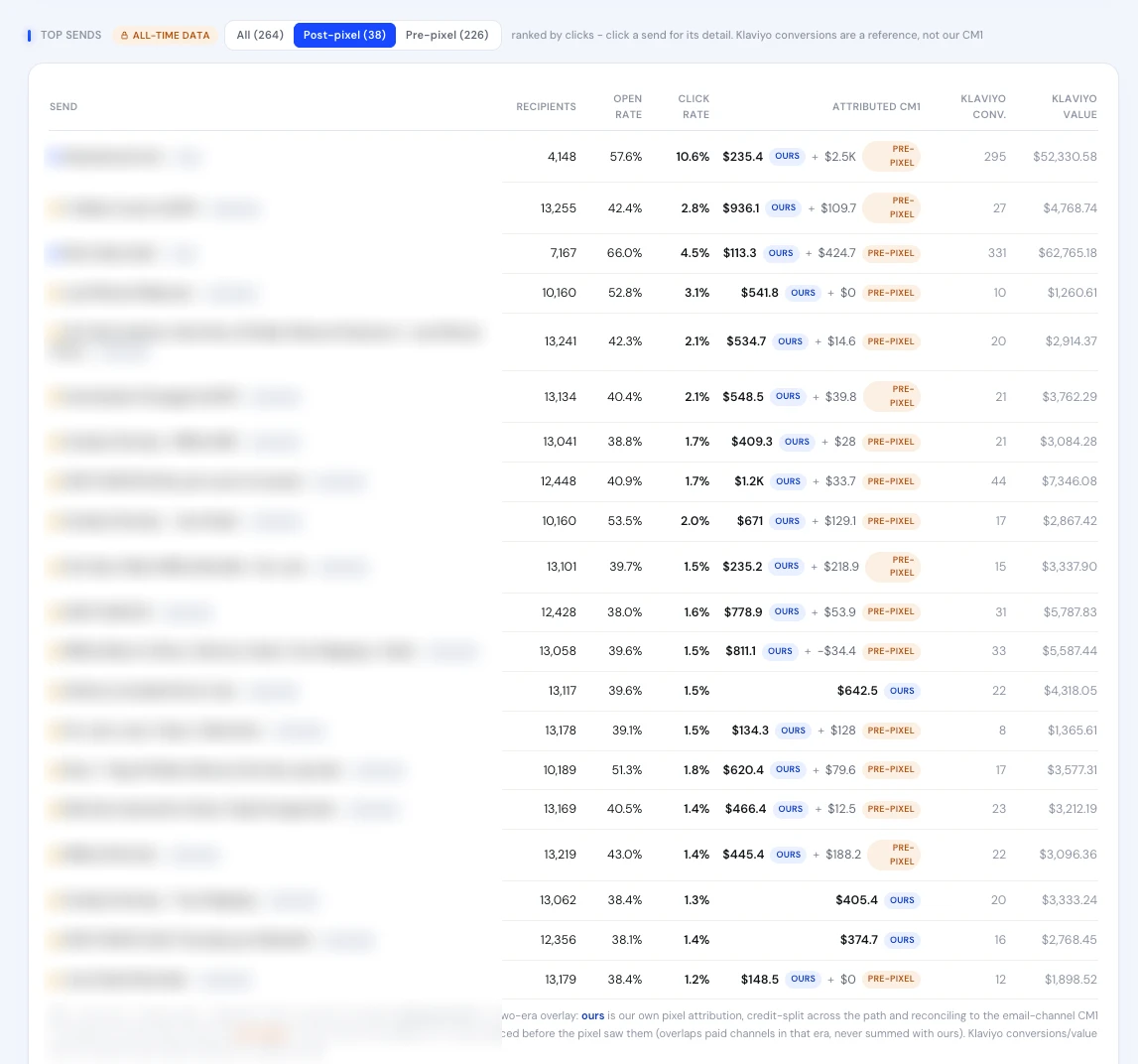
Real product screen, shown on sample data.
The team behind the numbers.
 A$0 to A$1Min under 12 months, in one of retail's most price-brutal categoriesRead the case study →
“…no request was too hard for them. Always clear communication and amazing results with the delivered product. Highly recommend Blufire.”














Where Klaviyo segmentation usually leaks margin.
- Building VIP tiers on spend.Spend rewards the big-basket buyer who only buys on discount. Rank on margin instead, as covered in VIPs losing money.
- Discounting win-back by default.Some lapsed customers come back without a code. A win-back offer should be sized to what the customer is still worth, and tested.
- Trusting the attribution window.Open-based attribution credits orders that would have happened anyway. An email or SMS holdout test shows what the send caused.
- Never checking the round trip.A segment pushed to Klaviyo is a hypothesis. Read what it returned in margin before you send to it again.