What's Inside / The marketing / S9 Activation Bridge
Klaviyo analytics on margin: send the audience, read the round trip
Klaviyo will tell you what a send's recipients bought. It cannot tell you whether they would have bought anyway, or what those orders were worth after the discount and the product cost. Section S9, the Activation Bridge, pushes audiences out to Klaviyo, Google or Meta and reads what came back in CM1.
Build the audience on margin, push it to Klaviyo, confirm it landed, and hold part of it out. Blufire's Activation Bridge then reads treatment against holdout in contribution margin, so you know whether the send paid for itself rather than what it touched.
5.0 on Google · 100+ businesses · $153M revenue influenced
Real product screen, shown on sample data.
Section S9: audiences go out, margin comes back.
Audiences start in Customer Value & Segmentation. Its Recommended audiences library ranks prebuilt segments, such as the top CM1 decile, full-price loyalists and fast-cadence VIPs, by the contribution margin at stake, each with a Send to Klaviyo button. The builder lets you combine conditions like entry category, first-order value and lifecycle state, and shows the matched audience's CM1 before you send.
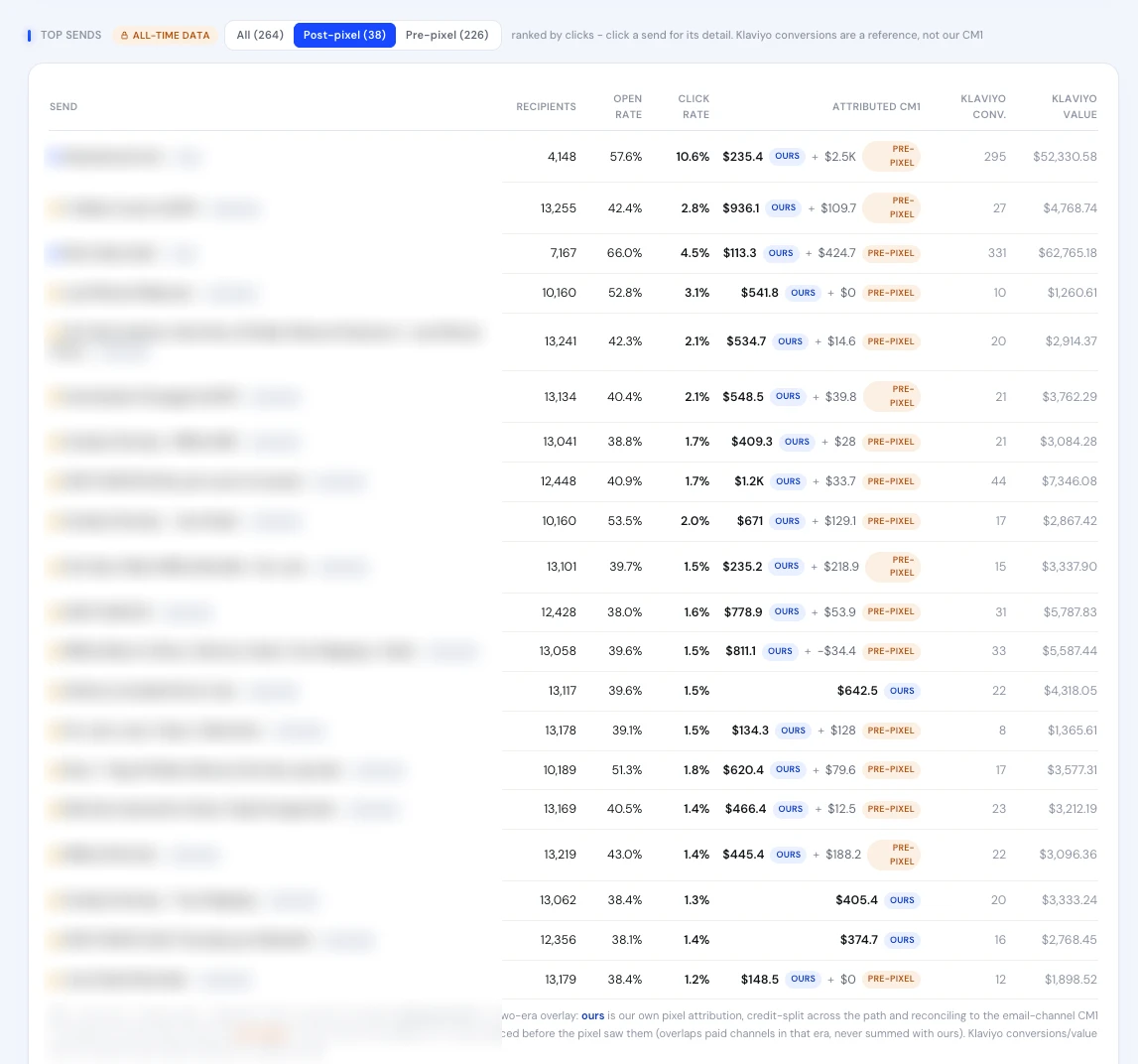
S9 is where that audience leaves and comes back. It keeps one registry of every audience with its lineage, schedules dispatches on a calendar, confirms each sync landed, and reads the result. The email campaign builder picks products with a margin-aware engine and runs as a dry run until you choose to schedule or send. On the sends view, Klaviyo's own conversions sit beside attributed CM1 as a reference, not as the answer.
“…no request was too hard for them. Always clear communication and amazing results with the delivered product. Highly recommend Blufire.”
 A$0 to A$1Min under 12 months, in one of retail's most price-brutal categoriesRead the case study →










One win-back send, read against its holdout.
An at-risk audience of 2,000 customers. 1,800 get a 10% off email; 200 are held out. A discounted order is A$90 with A$45 CM1; at full price it would have earned A$53 CM1.
Klaviyo credits the send with A$9,720. The honest answer is A$1,044 of margin. It stays positive only because a third of buyers were genuinely new; the holdout shows the other two thirds were coming anyway. Drop the holdout and there is no way to know.
The same method runs across flows and campaigns. For deeper causal tests, email and SMS holdouts are also set up in Experiments. See holdout test and win-back for the terms.
What S9 answers that Klaviyo reporting does not.
- Where are email and SMS leaving money on the table?The heart of the email and SMS problem: which sends earn margin and which just move discounted volume.
- Did the audience actually arrive?Sync health confirms the push landed. A segment that silently failed to sync reports nothing, and nobody notices.
- Did the send cause the orders?The payback ledger compares the treated audience with a holdout, so orders that were coming anyway are not counted as a win.
- Are we over-mailing our best customers?Audience pressure on the calendar shows when the same people sit in too many sends at once.
Klaviyo analytics today, and with S9.
A send is credited with every order its recipients placed.
A send is credited with the margin it caused, against a holdout.
Segments are built on opens, clicks and revenue.
Segments are ranked by the contribution margin at stake.
Nobody checks whether a synced segment actually landed.
Sync health and the intervention log confirm every push.
Email, Google and Meta audiences live in three places.
One canonical registry holds every audience, with lineage.
For the team that owns the list, and the one that pays for it.
Email and retention managers use S9 to send margin-ranked audiences instead of engagement-ranked ones, and to see which flows earn CM1 rather than open rates. The recommended library includes the move no revenue tool makes: customers to stop spending margin on, such as full-price loyalists who should never be trained to expect a code (see discounting).
Performance marketers use the same bridge for Google and Meta audiences, so a paid audience comes from the same registry, and is read the same way, as the email segment. Founders read the payback ledger to decide whether the owned channel deserves more effort, with the answer in the same CM1 the rest of the business uses.