
Why your CAC number is probably wrong
Two operators can both quote their cost to acquire a customer and both be telling the truth, while one number is nearly three times the other. The gap is not error. It is definition. And if you benchmark on the wrong one, you will either starve a healthy business or pour money into a leaking one.

Here is a question that sounds trivial and is not. What did it cost you to acquire a customer last month?
Ask a CFO, a head of growth and a Shopify dashboard the same question about the same business in the same month, and you will get three different answers. The CFO might say two hundred dollars. The growth lead might say eighty. The dashboard might say forty-five. None of them is lying. They are answering different questions and calling the answer by the same name.
This is the single most common confusion we see when we open a new account. CAC is treated as one number with one meaning, when in practice it is a family of numbers that diverge by design. The published benchmarks make it worse, because they quietly mix definitions, and most of the widely cited ones are US data. Shopify's own by-industry benchmark puts annual average customer acquisition cost at US$377 for electronics and around US$127 to US$129 for beauty, fashion, and home (US and global data, 2021, brands with fewer than four employees).1 The figure most operators carry in their heads for a healthy DTC brand is a blended US$68 to US$100 (about A$103 to A$152).2 Both are real. They are not measuring the same thing, and neither was measured in the Australian market.
The same brand, four CAC numbers
Take one brand spending a fixed amount on marketing in a single month. Depending on what you put in the numerator and the denominator, here is what its CAC looks like.
The brand did one thing. The number ranges from A$80 to A$250. If you benchmark the A$80 against an industry table built on all-in figures, you will conclude you are a category leader and add spend. If you benchmark the A$200 against a table of blended figures, you will conclude you are in trouble and cut. Same business, opposite decisions, both driven by a definition mismatch you never noticed. The trap gets deeper if the table is US data and yours is an Australian account, because Australian retail and ecommerce CAC tends to run lower than the US headline figures.
Three CACs, three questions
It helps to stop thinking of CAC as a number and start thinking of it as an answer to a specific question. There are three that matter, and they answer genuinely different things.
- Blended CAC. Total sales and marketing spend divided by every new customer from every channel, paid or not. It answers: how efficient is our whole marketing engine? Right for a mature brand with strong organic and referral, dangerous for a young brand because organic and word of mouth flatter it.
- Paid, or new-customer, CAC. Only the spend that bought traffic, divided by the customers that traffic produced. It answers: is our paid acquisition sustainable? This is the number that belongs in any cross-brand benchmark, because it isolates the part you actually control.3
- Marginal CAC. The cost of the next incremental customer, not the average. It answers: should we spend the next dollar here? It is the number almost every brand skips, and it is the one that governs whether scaling makes you more or less money.
The definitional split between blended, paid and marginal CAC is well established in operator finance literature.3 What is missing is benchmark data on the marginal figure, which is precisely why it gets ignored.
Why the marginal number is the one that bites
Average CAC is comforting because it stays roughly flat as you add budget. Marginal CAC does not. Paid channels saturate: the cheap, high-intent audiences get exhausted first, and each additional dollar reaches a slightly worse prospect than the last.4 So while your blended CAC reads a calm A$80, the customer you bought with this morning's budget increase may have cost A$250. You are still reporting the average. You are deciding at the margin.
Work the example. Suppose at A$30,000 of monthly paid spend you acquire 375 customers, a paid CAC of A$80. You raise spend to A$40,000 and acquire 415 customers. Your reported paid CAC barely moves, to about A$96. But the extra A$10,000 bought only 40 customers. That increment cost A$250 each. If your contribution margin per customer is A$150, the average still looks profitable while the marginal customers are losing you a hundred dollars apiece.
| Spend at the lower level | A$30,000 |
| Customers acquired | 375 |
| Spend after the increase | A$40,000 |
| Customers acquired | 415 |
| Reported (average) paid CAC at A$40k | A$96 |
| Incremental spend | A$10,000 |
| Incremental customers | 40 |
| Marginal CAC of the increase | A$250 |
The CFO who looks at the A$96 average signs off the budget increase. The contribution margin of A$150 cannot cover a A$250 acquisition cost, so the last slug of spend destroys profit even as revenue rises and the dashboard turns green. This is how a brand grows its top line and shrinks its bank balance at the same time, and why revenue is not the result, margin is.
The benchmark trap
Now the practical danger. Published CAC tables are a minefield because they rarely state which definition they used, and the definitions move the number by more than the differences between industries.
Per-channel figures attributed to Shopify's US merchants put Facebook acquisition near US$58 and Google Shopping near US$45 per customer.2 Shopify's by-industry figures land beauty at about US$127, fashion at about US$129, and electronics far higher at about US$377.1 These are not contradictory. The US$45 is a single-channel paid figure, the US$127 is a blended by-vertical figure, and the US$377 is a high-cost-category all-in figure. Stack them on one chart without labels and you would assume the market had lost its mind. Stack a US table against an Australian account, where local acquisition cost reportedly runs about 20 to 35% higher again,5 and the confusion compounds.
How to fix your CAC number
You do not need a new platform to stop making this mistake. You need three disciplines.
- Pick the definition before you pull the number.Decide whether the question is engine efficiency (blended), paid sustainability (paid CAC) or the next-dollar decision (marginal). Write it down. Most arguments about whether CAC is "good" are really arguments about which CAC.
- Benchmark like against like.Never compare your number to an external table unless you know the table's definition. If it does not say, treat it as directional at best. A paid CAC belongs against paid benchmarks, never against an all-in retail average.
- Judge CAC with payback, never alone. A A$250 CAC that pays back in two months on a high-repeat product can be far healthier than a A$80 CAC that takes a year on a one-and-done purchase. CAC without payback context is a number waiting to mislead you.
This is the heart of profit-led measurement: stop steering on whichever CAC reads lowest, and start steering on the marginal cost of the next customer against the contribution margin that customer will actually return. That combination, the rate at which spend converts into durable contribution margin, is what we call Profit Velocity. It rises when the next customer costs less than they are worth, and falls the moment it does not.
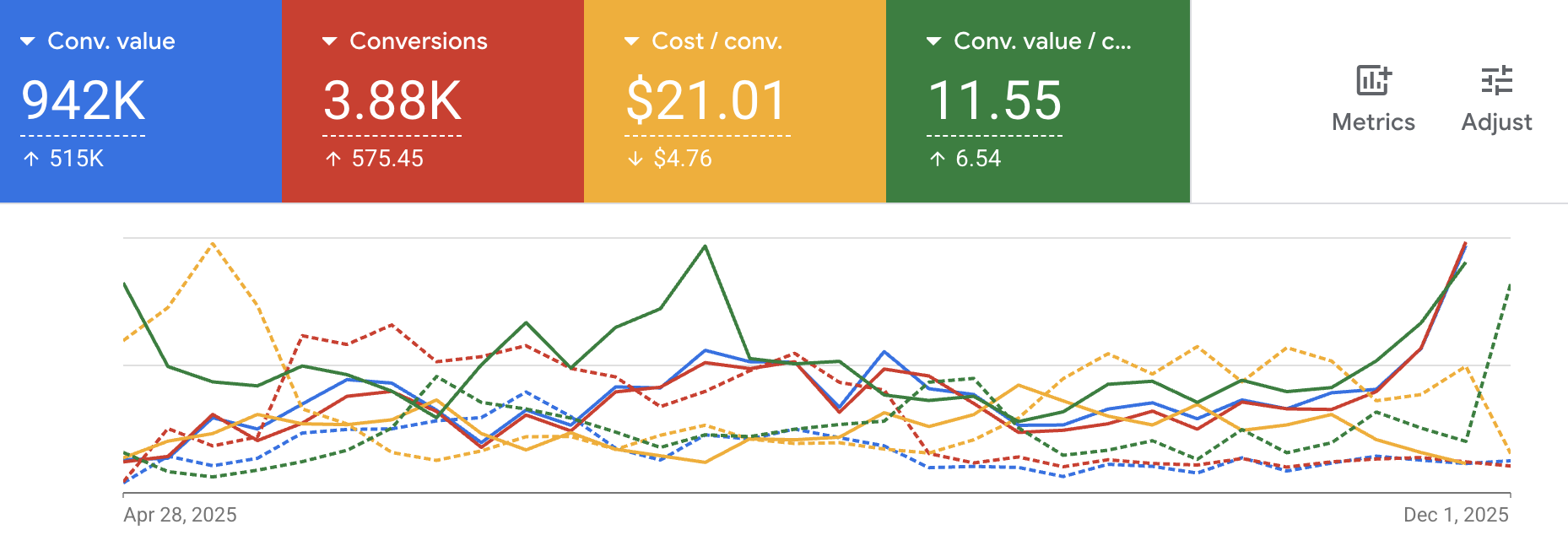
When we rebuilt acquisition around the customers who actually paid back rather than the lowest reported CAC, Peter Jackson cut its cost to acquire by 53% and drove $1.2M in incremental revenue at a 9.36 blended ROAS. The lever was not a cheaper channel. It was measuring the right number.
The lesson is unglamorous and durable. CAC is not wrong because the math is hard. It is wrong because three different numbers wear the same name, and the one that governs whether scaling makes you money is the one almost nobody computes. Decide which CAC you mean, benchmark it honestly, and read it next to payback. Do that, and the number stops lying to you.
Sources
- Shopify, "Customer Acquisition Costs by Industry": annual average CAC by industry of electronics US$377, fashion and accessories US$129, home and garden US$129, health and beauty US$127, arts and entertainment US$21. Underlying data collected by Shopify in 2021 for brands with fewer than four employees; page updated 2025. US and global data, primary-published, not Australian. shopify.com
- Blended US DTC CAC range of roughly US$68 to US$100, and per-channel figures attributed to Shopify merchants (Facebook ~US$58, Google Shopping ~US$45), 2024 to 2026, aggregator-reported. US data. AUD approximations in the text use US$1 = A$1.52 (mid-2026, approximate). ringly.io
- 1-800-D2C and SaaS Metrics Board, definitional distinction between blended, paid / new-customer and marginal CAC, with marginal CAC noted as the metric most brands skip. 1800d2c.com
- Recast, channel saturation and diminishing returns in paid media; each incremental dollar reaches a worse prospect than the last. getrecast.com
- Australian context: no genuinely Australian retail CAC figure is published to a primary source (local agency CAC tables largely re-label US WordStream data). An Australian FMCG and ecommerce consultancy reports only that local CAC tends to run roughly 20 to 35% higher than US averages. Directional, not a measured AU benchmark. uncommoninsights.com.au
Demonstrative figures are modelled illustrations in Australian dollars (A$) sized to the cited published ranges; they are not measured Blufire client data. Cited external benchmarks are US data labelled US$ and attributed to their publishers above; AUD approximations use US$1 = A$1.52 (mid-2026, approximate). There is no Australian retail CAC figure published to a primary source; directional estimates disagree on both direction and magnitude (one consultancy reports AU CAC running 20 to 35% higher than US averages, while vendor calculators quote AU retail and ecommerce ranges near A$25 to A$85 with methodology not disclosed), so we treat the cited US figures as the shape of the definition gap, not local levels. "Profit Velocity" is an owned Blufire metric, the rate at which spend converts into durable contribution margin.
Two people look at the same campaign. Marketing reports a 4x return on ad spend. The CFO reports a loss. Both are right. The number that reconciles them is contribution margin, and most operators never compute it.
Blended, new-customer and marginal CAC are three different numbers that answer three different questions. Most decks report one and reason as if it were another. The expensive one is the one almost nobody computes.
Most operators treat weather as noise to apologise for in a bad month. It is a measurable, leading demand signal. Here is the math that turns a cold snap into a budget decision you can make 30 days early.