A variance per line, explained to zero.
| Term | What it means |
|---|---|
| Reported figure | What your store or analytics says: net revenue, fees, shipping, COGS, contribution margin. |
| Ledger anchor | An independent record for the same line and the same period. It must not come from the system being checked. |
| Explained | Traced to named causes that sum exactly to the variance. "Close enough" is not a finish line; a small gap can be two large errors cancelling. |
The ledger reconciliation glossary entry walks a single revenue variance. This page does the whole margin: every line of the step-down from CM1 to CM3 gets its own anchor.
A $5.76M store, reconciled to the dollar.
The tie-out ledger published on The Math: 40,099 orders and 19,217 customers, tied out with provenance on every figure.
The arithmetic is simple: $5.76M less $3.34M, $620k and $450k leaves $1.35M, which is 23.4% of revenue. What makes it a receipt is that every one of those four inputs was checked against an independent anchor before the total was allowed to ship.
One month, line by line.
Analytics against anchors for a single month. Revenue is out by A$700. Contribution margin is out by A$2,250.
| Line | Analytics | Ledger anchor | Variance | Traced to |
|---|---|---|---|---|
| Net revenue | A$184,600 | A$183,900 (payouts + ledger) | A$700 | Refund processed on the 31st, booked this month in the ledger, next month in analytics |
| Landed COGS | A$77,500 | A$77,500 (units sold × landed cost) | A$0 | Matched |
| Shipping | A$16,200 | A$17,480 (carrier invoices) | −A$1,280 | Redelivery and address-correction surcharges billed after dispatch |
| Payment fees | A$6,850 | A$7,120 (processor statement) | −A$270 | Currency conversion fees on international orders |
| Contribution margin | A$84,050 (45.5%) | A$81,800 (44.5%) | A$2,250 | The three traced items, summed |
Worked example / demonstrative numbers. Revenue was 0.4% out; contribution margin was 2.75% out (A$2,250 ÷ A$81,800). A revenue-only reconciliation would have passed this month.
Reconcile from the top line down.
Revenue first. Tie net revenue to processor payouts plus the ledger, with refunds, chargebacks and gift cards named. Gift cards are a liability until redeemed, not revenue when sold, and a P&L statement that books them early will never tie out.
Then each cost, to its own anchor. Fees to the processor statement, because they are netted out before the payout and never arrive as a bill. Shipping to carrier invoices, because surcharges land weeks after the label. COGS to units sold at landed cost, not to purchase orders.
Then the lines that cannot be reconciled. Attribution is modelled credit, not measured money, so no ledger will ever confirm it. What you can reconcile is total ad spend to the platform invoices. How much of it each channel caused is a separate job, covered on platform over-claiming.
Every figure checked before it reaches you.
Blufire reconciles each figure to an independent anchor before it ships, then shows its working. Section S1, Executive, puts a Data Health page behind every number, with connector status, so you can see when a figure can be trusted and when a feed is missing.
The biggest movers view ranks what helped and hurt contribution margin by product, category, region and segment against the prior period, and any row opens the orders behind it. Provenance is one click, not a request to the analyst.
- Data HealthSits behind every number, with connector status, so you can verify any figure.
- What ChangedDecomposes the period's move line by line.
- Role lensesThe read built for each seat, down to a CFO scorecard over time.
- CM waterfall & bridgeIn S2 Unit Economics: each cost line on the way from revenue to margin.
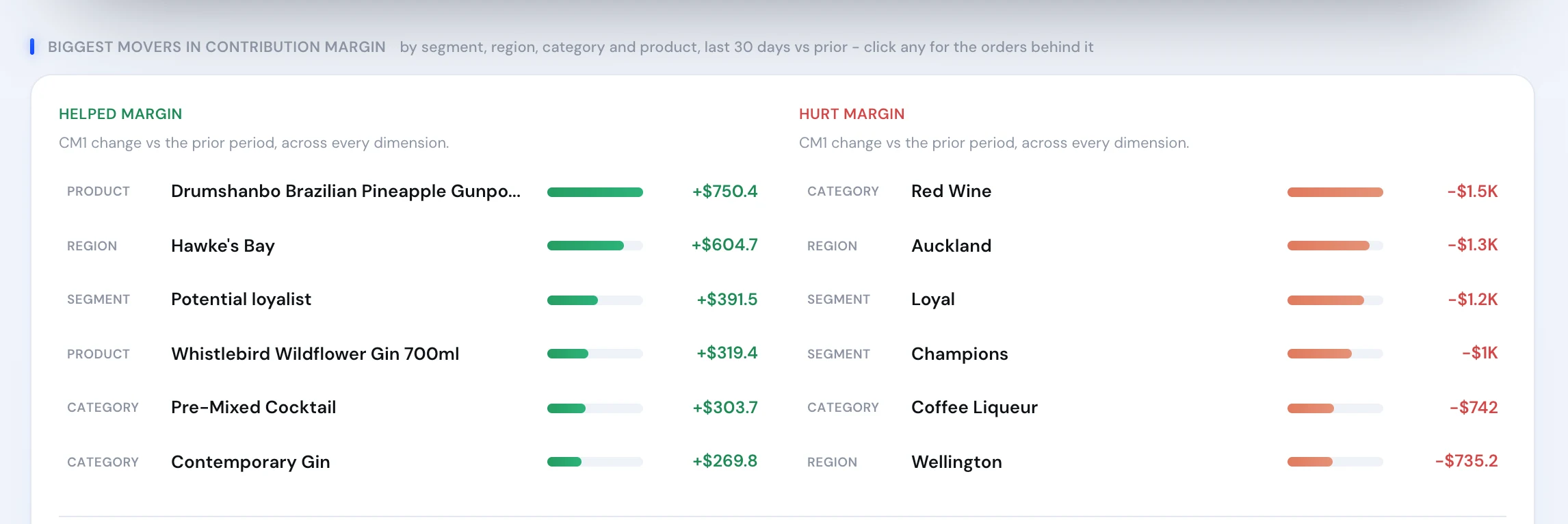
Real product screen, shown on sample data.
The four rules every figure operates under.
As published on The Math. A receipt is only worth signing if the process behind it is strict.
- 01 Reconciled to an anchor.Every figure reconciles to an independent anchor before it ships. Not modelled against itself: checked against your ledger.
- 02 No fabricated zeros.A missing cost is never coalesced to zero. A gap shows as a gap, never as a number that flatters the margin.
- 03 Estimates say so.Where a number rests on an estimate, it is labelled, so you always know which figures are measured and which are modelled.
- 04 Method in the open.Every formula is shown. Worked examples use demonstrative numbers, flagged as such. External benchmarks are cited to their source.
Where ecommerce reconciliation goes wrong.
- Reconciling revenue only.The worked example passes on revenue and fails on margin. Each cost line needs its own anchor.
- Using the dashboard as its own anchor.Checking a report against the system that produced it proves nothing. The anchor must be independent.
- Forcing a tie-out with a zero.Filling an unknown freight or fee with zero makes the numbers match and the margin wrong. Show the gap.
- Reconciling once.Every new app, market and fee change reintroduces drift. Tie out every reporting cycle so each variance stays small enough to trace.
“I couldn't be more impressed with the Blufire team and the improvements they have made… working on the account and maximising results daily.”
 A$942kin incremental revenue once the double-counted attribution was fixedRead the case study →
5.0 on Google · 100+ businesses · $153M revenue influenced