What's Inside / The marketing
Spend where profitable customers actually come from.
Attribution you can interrogate, channels read in CM1, audiences that land in the platforms and report back, and creative ranked by what it earns.
Audiences go out, margin comes back
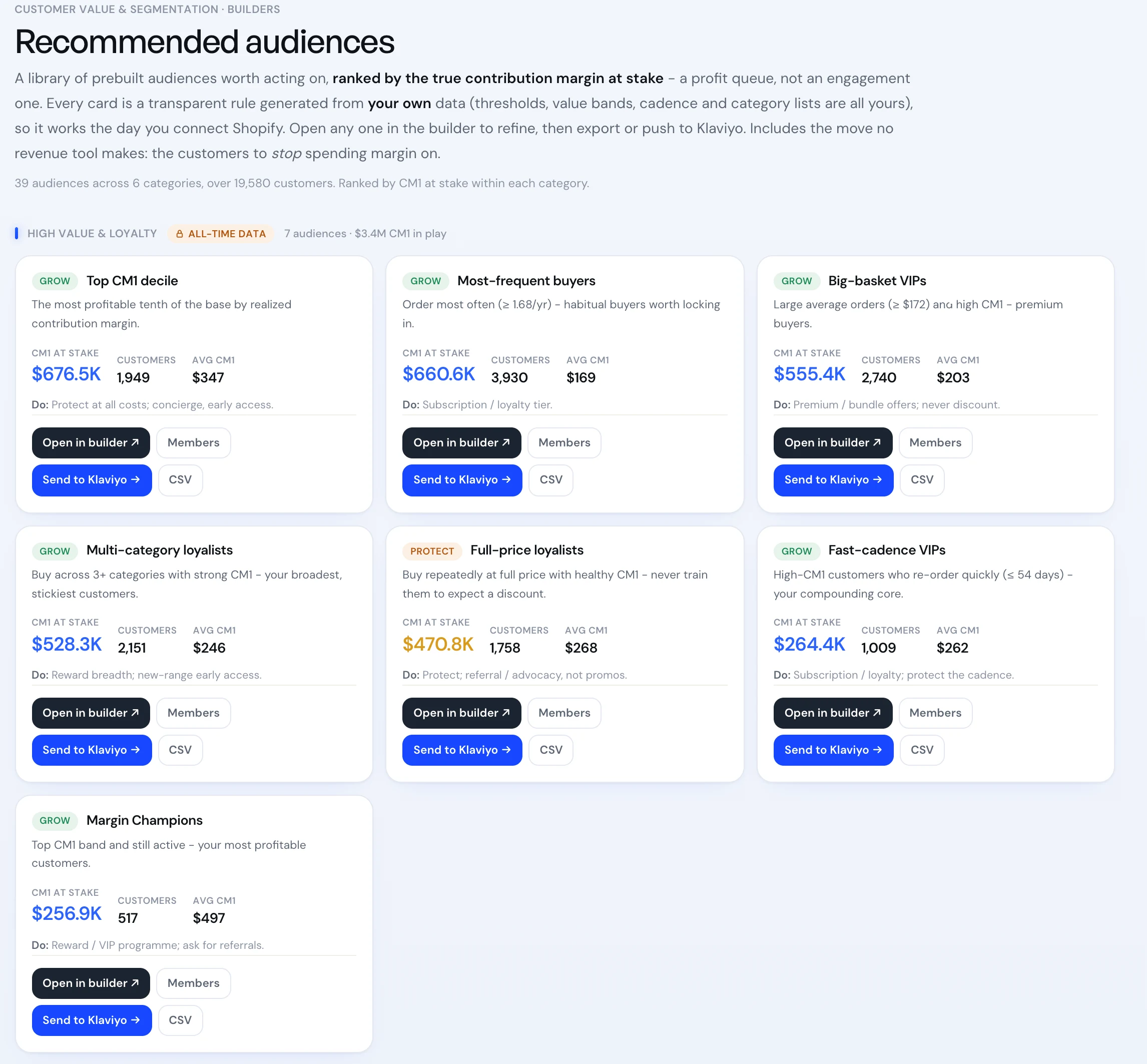
Product screens from a live store. Client name withheld.
The four sections in this group.
Attribution models compared side by side instead of trusted blindly: the journeys customers actually take, where the funnel leaks, and one published source-of-truth mapping that every other section reads.
- You can reconcile models in one comparison matrix, then publish the canonical source map
- You can grade each channel's arrival quality and catch drift early
- You can clean up UTM hygiene and read your top conversion paths
Channel x customer x product in one CM1 view - whether each channel is acquiring profitable customers, what those customers become, and how email and SMS flows really stack up against campaigns.
- You can compare per-source customer profiles side by side
- You can decompose blended CM1-MER into each channel's contribution
- You can read the SKU x channel matrix to see which products travel through which channels
Push an audience to Klaviyo, Google or Meta and know it actually landed - then read the round trip in CM1 to see whether the activation paid for itself.
- You can schedule dispatches on the activation calendar and watch audience pressure
- You can keep one canonical audience registry with full lineage
- You can read each audience's payback ledger, treatment against holdout
Every ad asset ranked by the margin it earns, fatigue caught before it bleeds spend, and the attributes that win surfaced - margin-true, not platform ROAS.
- You can work the refresh queue straight off the fatigue board
- You can read format x placement performance and clean test readouts
- You can reconcile platform spend against what the data honestly shows
The terms this group runs on.
Every one is defined in full, with the formula and a worked example, in the glossary. Free, no signup.
Built for these seats.
The jobs it does.
Thirteen sections. One number.
Every group reads the same CM1 math underneath, so the figures tie out across all four.